Monthly Archives: May 2026

Jonestown Aftermath – The Cover-Up

Reference: The Jonestown Massacre – And the Assassination of Leo J. Ryan

We have examined how the record of Congressman Leo J. Ryan leading up to the 1978 Jonestown massacre leaves serious questions about the U.S. government’s (and specifically the Military Industrial Intelligence Complex – MIIC) role in that event. We will now examine the events concerning Ryan that occurred after his death which add gravity and scope to the questions raised about the government’s role.

Ryan’s mission was to make the government transparent and the lives of Americans safe from unreasonable intrusion by that government. In his view the Constitution and Bill of Rights demanded that state of affairs. He was aggressively opposed by those in pursuit of the polar opposite, the MIIC. By 1977 the Congressional policing of intelligence agencies by the likes of Rep. Otis Pike (chairman of the temporary House Select Committee on Intelligence) and Rep. Leo J. Ryan (the most active and confrontational intelligence watchdog on the House Foreign Affairs Committee) had driven the Intelligence Community to seek relief at the highest levels of Congress. House Majority Leader Tip O’Neill (D-MA) was the perfect agent for the change they wished to effectuate.

O’Neill would later be remembered as the hard drinking “hale fellow well met” who helped establish the de facto American uniparty by abandoning critical liberal principles to “work across the aisle” with his longtime political opposite, Ronald Reagan. O’Neill personally orchestrated the solution designed to sideline the Pike/Ryan style of oversight once and for all. On July 14, 1977, the House passed H. Res. 658, creating the House Permanent Select Committee on Intelligence (HPSCI). Its creation formally abolished the temporary Pike Committee and thus depowered Pike as a reform agent. The new body’s explicit mission was to centralize and coordinate all intelligence oversight into one controllable locale — effectively obviating the need for the likes of Ryan and his pesky, independent work on the Foreign Affairs Committee.

From day one, the fix was in. O’Neill hand-picked his close friend and former roommate, Rep. Edward P. Boland (D-MA), as chairman and installed Tom Latimer — a veteran of senior intelligence-community posts — as Staff Director. The new committee was deliberately structured to be chairman-controlled, with limited security clearances and a cooperative relationship with the Director of Central Intelligence (DCI, then head of both the CIA and coordinator of the other 15 US intelligence agencies, including all military intelligence branches).  
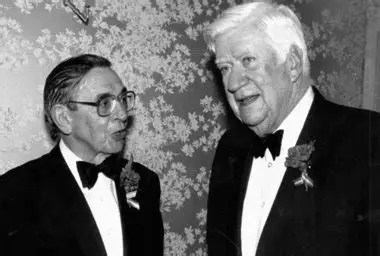
Rep. Edward Boland with Speaker Tip O’Neill

Boland and Latimer worked overtime to protect Intelligence agencies from the prying eyes of Congress, and thus the American people. A 12 September 1978 CIA memo states “Representative Boland introduced amendments which insured that Intelligence Community classified information would be protected from disclosure under the Special Counsel provisions of the Civil Service Reform Bill.” (See 12 Sep 78 CIA memo) The 20 September 1978 follow up, syrupy thank you note from the DCI to Boland demonstrates how unnaturally cozy the relationship the designated watchdog had with those he was entrusted to police. (See 20 Sep 78 DCI letter) Compare that to what the DCI received just 7 days later from Leo J. Ryan (27 Sept 78 Letter Ryan and DCI). 

An October 31, 1978 CIA memorandum to the DCI demonstrates the complete power the agency exercised over the single point of Congressional oversight remaining. The CIA’s Legislative Counsel passes on to the DCI a tip given to him by none other than the “aide” to Chairman Ed Boland. It suggests the DCI call Boland directly to encourage a measure to narrow even further the number of staffers who might be made privy to CIA covert ops. Read the entire memo (See Oct 31 1978 CIA memo); it clearly indicates the CIA is not only spying on the committee created to oversee its inappropriate spying it is also taking secret action on that intelligence (the definition of a covert operation). While Boland and Latimer quietly managed that relationship (as the October 31, 1978 CIA memo makes clear — the very day Ryan’s Fraser Subcommittee released its explosive report on the Moonies/KCIA), Ryan kept operating the old way: pressing Hughes-Ryan Amendment (requiring CIA to inform the President in advance of covert operations and inform designated members of Congress in a timely manner thereafter) enforcement, demanding answers on the Hearst matter and Jonestown, and refusing to accept State Department/CIA stonewalling . There you have the fuller background leading to the November 18, 1978 assassination of Ryan. 

The Final and Bigger Cover-up

The dark side of the 1980s “Reagan Revolution” was the reinstitution of pre-70’s MIIC secret power and rule over America. It began with the burying of the legacy of U.S. House Representative Leo J. Ryan.

By early 1980 Boland and Latimer were dismantling the authority Ryan had used to police the CIA. The attached 1 Feb 1980 memo from CIA Legislative Counsel to the DCI reports as follows:

“I have since learned that the HPSCI met as a Committee on Hughes-Ryan on 31 January 1980…Although Mr. Aspin wants prior notification of covert action operations, Mr. Latimer confides that Chairman Boland realizes the President will never consent to this. There is clear majority on HPSCI, according to Mr. Latimer, in favor of Hughes-Ryan change.” (See 1 Feb 1980 memo

By early 1980, Democrat President Carter was hearing the footsteps of Republican Ronald Reagan and his “Make America Great Again” crusade approaching the White House. Several months into the embarrassing takeover and hostage taking in the U.S. Embassy in Tehran Iran, Carter and his administration were rapidly becoming less interested in restoration of civil rights and more interested in projecting a strong military and state security (MIIC). A 22 May 1980 Memorandum from Director of Central Intelligence (Stansfield Turner) to President Carter demonstrates this shift. In it the DCI asks for the President’s personal intervention to assist his effort to further weaken the Hughes-Ryan Amendment to the Intelligence Oversight Act.  (See 22 May 1980 memo)

Carter would respond and Edward Boland would eagerly carry out the CIA objectives. The Intelligence Oversight Act of 1980 would repeal in significant part the Hughes-Ryan Amendment. It passed the Senate 89-1 on 3 June 1980.  Carter signed it into law on October 14 of that year.  They effectively buried the tool that Ryan had left his Congressional colleagues with to carry on his mission of making government transparent and the public protected from privacy intrusion by the government. It would be too little, too late for Carter, whose electoral showdown with Reagan was only weeks away.

The appointed Congressional CIA watchdog was progressively becoming the CIA’s attack dog throughout the year. The attached 11 April St. Louis Post-Dispatch article evidences that:


“Should the Central Intelligence Agency be using American news reporters as part-time spies?  The question arose again Thursday in a confrontation between CIA Director Stansfield Turner and some of the nation’s top newspaper editors. Turner said that under his authorization three journalists had agreed to undertake intelligence assignments and underwent security checks.”  You will never guess whose dress Turner hid behind for protection from the media’s wrath. “[Turner] added that Rep. Edward P. Boland, D-Mass, chairman of the House Intelligence Committee, had reviewed the decision and “’found it perfectly reasonable’.” The article went on, “Reps. Boland and Les Aspin, D-Wisc, chairman of the House Intelligence Oversight Subcommittee, both inquired into the three cases and concluded that Turner had not been abusing the loophole in the CIA regulations.” (See St. Louis Post-Dispatch)

Now, imagine what would have happened In April 1980 had Leo J. Ryan been alive. Just from what you have learned in this series, do you believe he would have stood for the Central Intelligence Agency infiltrating the media to use it as a state propaganda vehicle?  Of course not. Unfortunately, Ryan was the last of the uncorrupted Mohicans in Congress, which has led us to today when it is difficult to discover any media information that is not government sponsored or censored. 

Jonestown laid to rest

On a parallel track, in 1980 Boland also personally put period to growing public suspicion that the CIA was involved in Jonestown and the assassination of Leo J. Ryan. He did so in collusion with the Chairman of Leo Ryan’s House Foreign Affairs Committee, Clement Zablocki (D-Wi). The latter was a staunch Vietnam War enabler and, like Boland, friend of the MIIC. He was rankled by Ryan’s high-profile muckraking of the cult of intelligence. With Ryan out of the way he joined in Boland’s efforts to neuter and repeal the Hughes-Ryan amendment, literally depowering his own Committee of any intelligence oversight function. In voting against continuing the Hughes-Ryan Amendment’s requirement that the CIA report operations to his own committee, Zablocki told the press “If we are to have an effective foreign intelligence capability…we must take steps to reduce the likelihood of leaks to an absolute minimum.”  Apparently, murdering Leo Ryan wasn’t a sufficient guarantee of CIA secrecy.  (see Zablocki weakens Hughes-Ryan).  Zablocki went further in the autumn of 1980, voting “to allow a president to ignore rules on advance notice of operations if he thinks even the leaders of congressional intelligence committees should not be told…” It apparently wasn’t enough to block his own Foreign Affairs Committee receiving notice, so he voted to extend that blindness to even the HPSCI if the president wished to. (see, Leeway in Secret Operations of CIA Approved by Panel, Aug 1 1980)

After overseeing two hearings and an investigation into Jonestown and finding no culpability of the State/CIA apparatus, by early 1980 public opinion considered Zablocki’s Foreign Affairs Committee as part of the problem. 

In early 1980 Zablocki punted the ball to his comrade Edward Boland and the HPSCI to put the accusations about the CIA to rest.  While calling for a final investigation of the matter, Zablocki clearly had already concluded that there was nothing to find, and so announced it to the media: “At no time was there any indication that the CIA was ever involved in Jonestown.” (see Committee Investigates Jonestown, CIA Connection – State News Service 5/25/80) According to Boland’s staff director Michael O’Neill the committee would limit its work to existing documents without interviewing witnesses.

For several months, not a peep arose from the Boland committee investigation. Then on 27 September 1980 the Washington Post’s Jack Anderson dropped his syndicated bomb detailing a load of evidence of CIA involvement in Jonestown. Among other things, he published:

  • Ryan’s Aide Holsinger receiving a call from the White House the day of the Jonestown giving a body count, claiming the info came from “a CIA report from the scene.”
  • A recording of Jim Jones at the time the mass suicide was in play screaming to his aides to “Get Dwyer (CIA operative Richard Dwyer) out of here before anything happens to him.” 
  • “Discovery of a huge cache of arms and drugs like Quaaludes, Valium, Demerol and Thorazine” (all psychiatric drugs used in MK Ultra).
  • “House probers particularly want to find out if Ryan’s requests to the State Department for accurate information on conditions at Jonestown were turned down to protect CIA covert operations in Guyana.”

(See 27 Sep 80 Jack Anderson column)

Suddenly, and apparently magically, Boland’s investigators were awakened from their deep, long sleep. Just three days after the Anderson column was published Boland – who worked tirelessly for the CIA to guard government secrecy – got his own counter story out on the wires. It stated: “The House Intelligence Committee has expanded its investigation into alleged CIA involvement with the Peoples Temple Cult and Jonestown bloodbath in November 1978.”Apparently worried the Anderson column would engender great scrutiny, suddenly it was no longer simpl an existing document review as it had asserted in the May 25 article cited above. In its eagerness to project thoroughness, it admitted – that far beyond its original mandate it was interviewing CIA agents: “While he acknowledged that some CIA agents had been questioned, O’Neill (Boland’s investigator) declined to divulge their names.”He did not then, nor ever, disclose a single “fact” he learned from those unnamed CIA contacts. Again, Ryan’s former committee chairman – who was not part of the investigating committee and in fact had requested the probe – gratuitously forwarded the coverup: “[Zablocki] said he doubted the CIA connection but added the matter is outside the jurisdiction of his panel.” O’Neill represented, “initial presentations will be made in executive session with no public access…He added that some investigative material would be declassified.” (See Sep 30 1980 article)

Then more crickets for two months. 

Finally, Boland and Zablocki would perform a sort of Satanic ritual by exchanging a letter putting the matter to rest on the exact date (two years later) that Leo J. Ryan gave up his life to prevent such sinister intelligence games. In the November 18, 1980 letter Boland announced to Zablocki that “the committee has found no evidence at all to suggest the CIA knew anything about the Jonestown tragedy before it occurred, or that the agency had any connection with either Jim Jones or the People’s Temple.” (See Newhouse News Service) Despite the promise that “investigative material would be declassified”, it was not and has not been to this day. Nor apparently has the letter itself been published or preserved.

Epilogue

       By the end of 1980 the CIA and its man in Congress Boland had put the legacy of Leo J. Ryan to rest along with his groundbreaking legislation, the Hughes-Ryan Amendment. With their nemesis eliminated, they wasted no time in continuing to erase the lessons learned in the 70’s by unleashing the Military Industrial Intelligence Complex to effectively neuter and kill the First and Fourth Amendments to the U.S. constitution.  By mid-decade the White House and CIA were getting away with foreign and domestic operations that Leo J. Ryan would have killed in their tracks (Iran/Contras scandal, CIA drug running through Rural America, and CIA flooding black urban neighborhoods with cocaine setting off the crack epidemic and inner city decay).  Ironically, even the Unification Church (Moonies) intelligence operation that Ryan was onto like white on rice in 1978 was linked to the CIA Contras scandal. Jack Anderson reported a Moonies front group was supporting  the Contras in Nicaragua – in spite of Congress’ outlawing such activity. (See Anderson Moonies and Contras). All of it was protected by Edward Boland’s single oversight channel, the HPSCI, under the complete control of the agency it was formed to police.

While no good acts of Leo J. Ryan’s went unpunished, the American oligarchy treated Edward Boland by different rules.  Upon retirement in 1984 he was showered with honors by both the White House and the CIA.  A Sept 24 memo from Associate Counsel HPSCI to the office of legislative affairs the CIA boasts of Boland’s achievements: “endorsing and authorizing initiatives to modernize and re-build our intelligence capabilities worldwide”, creating “a new era in cooperation with the Intelligence Community and Congress”, and noting that “Mr. Boland…will be presented with Letters of Appreciation from President Reagan and former President Carter…” (See First Sept 24 memo) A second memo of the same date to the DDCI gave talking points for his address that evening at the special honoring of Boland, and included: “[Boland’s] leadership has been fair, reasonably bipartisan, open and always in support of a strong U.S. intelligence function.” (See Second Sept 24 memo)

From that point until today MIIC secrecy, security, and propaganda measures have increased unabated. So too have group Mind Control measures increased, implementing forty years of CIA experimentation. The result is that the right to privacy has been effectively eviscerated while the freedoms of thought and conscience have been invaded in pervasive, mind-numbing fashion. 

In a morbid twist, the leading CIA MK Ultra shock doctor Jolyon “Jolly” West (see, Jolly West to Mk Ultra Boss, and the posts it references) would help turn Ryan’s tragedy into a colossal diversion from the CIA Mind Control program rolling out from laboratories into society-wide applications. In a grotesque misappropriation West would later claim the “Leo J. Ryan” award for crusading against cults. That campaign turned out to be a sham. West and his colleagues would use their “anti-cult” fronts to hunt MK Ultra dissent and exposure. Meanwhile, they would pay scant attention to the cults that employed the same methodologies of those used by the Jones’ Peoples Temple. Our next article will examine those methods, their MK Ultra origins and the groups that exercised them. 

The Jonestown Massacre

And the Assassination of Leo J. Ryan

Reference: Leo J. Ryan vs. Frank Carlucci and CIA and SLA Cult Part II

The Jonestown Guyana massacre of 18 November 1978 set into motion one of the largest media shock treatments ever implanted upon the American psyche. Forevermore Americans would shiver at the mention of “cults” and equate following any irrational, destructive path with “drinking the Kool Aid.” As the official, one-dimensional narrative has schooled us, the head of the People’s Temple cult in Guyana persuaded over 900 Americans to commit suicide in unison by drinking Kool-Aid laced with cyanide solely by the power invested in him by being a “cult” leader. The reactive equation branded in American minds was cult=death. 

What few remember today though is the far-reaching chain of irregularities in the investigation and coverup of the event that gave immediate birth to conspiracy theories that have survived – and sometimes thrived – to this day.  For the most part those theories revolve around the CIA’s involvement with – and apparent protection of – the leader of the People’s Temple, Jim Jones.  

Most of the work on those theories are included in the largest and most definitive archive on the subject of Jonestown which is maintained at San Diego State University (Jonestown & People’s Temple, A Digital Archive).  It was created and is curated by Rebecca Moore and her husband Fielding M. McGehee. They began their work shortly after the tragedy and it continues to this day, forty-seven years later. Ms. Moore’s interest was personally driven; she wanted answers as her two sisters were causalities of Jonestown.

While Ms. Moore seems unconvinced of some of the conspiracy theories, in her devotion to seeking the whole truth, she includes in the archives the best developed conspiracy work on the subject as well as the most vehement attempts to debunk that work.

The alternate histories point to and document, among many other anomalies, the following little-known facts:

  1. Longtime CIA connections to People’s Temple (PT) leader Jim Jones.
  2. CIA chemical experimentation background of Jones’ biggest donor – whose wife, daughter and son became top Jones’ insiders and enablers.
  3. The CIA’s involvement in years of then-ongoing covert operations to preserve the power of the tin pot dictator it had installed in Guyana. 
  4. The State Dept/CIA consequently conceded/granted full authority/responsibility for American citizens at Jonestown to that regime, which consequently dutifully served Jones and PT.
  5. The massive stores of MK Ultra (CIA Mind Control experiments) drugs found at Jonestown.
  6. Evidence that many people publicized as having committed suicide through voluntarily imbibing cyanide laced Kool-Aid were actually stabbed in the back with syringes filled with cyanide.
  7. The lack of standard medical examiner autopsy procedures applied to the victims postmortem.
  8. The CIA friendly Guyana regime’s torching of all official records maintained on Jonestown.
  9. The military-precision of the assassination of Ryan and many unexplained oddities surrounding the event – most prominent of which was the CIA-friendly Guyanan military apparent witnessing and enabling of the event.

Perhaps the most credible indication that there was in fact a nefarious CIA connection comes from the voice of reason concerning Jonestown, conspiracy skeptic Rebecca Moore. She and her husband battled the CIA over withheld Freedom of Information Act documents concerning Jonestown for several years in Federal District Court and up to the Federal Circuit Court of Appeals and back again. Rebecca and Fielding established settled FOIA law along the way and put the CIA’s feet to the fire (see e.g., https://www.nytimes.com/1983/01/10/us/appeals-court-rebukes-cia-in-jonestown-information-case.html) Yet, in the end the system enabled the CIA to conceal the truth. Rebecca once shared these thoughts on the matter:

The CIA has toppled foreign governments, financed strikes, incited riots, encouraged and executed political assassinations, all for the sake of our national security. And are we more secure?

Certainly the CIA’s information on Jonestown might help answer that question. Did it have foreknowledge of the suicides, or of the assassination plans. Did it encourage the paranoia endemic in the community? Did it set up Ryan for a hit? If it did not know about Jonestown, why didn’t it? Was the number of drugs present in Jonestown sufficient to characterize the project as a mind control experiment? And did the CIA sponsor the experiment?

We are seeking “conclusive evidence” which will either exonerate the agency or condemn it. The inconclusive evidence we’ve seen so far suggests that the CIA expanded its interest in Guyana to include 1000 Americans who set up a community in that country. The inconclusive evidence hints of CIA monitoring, and perhaps infiltration and manipulation, of Jonestown activities. The inconclusive evidence indicates the CIA knew more about the suicides than it has told anyone.

The people of Jonestown were American citizens. If the CIA knew what was going to happen, and let it, then Fred Branfman is right when he says that, “the major enemy … will not be the KGB or the Chinese or anyone else abroad. It will be the CIA.”

When even those demonstrably most well-informed and even-keeled raise such concerns, to accept the official narrative lock, stock and barrel would be the epitome of gullibility.

Rather than relitigate matters that can be disputed, which might take a lifetime, I will rely almost entirely upon the Congressional record to establish how Ms. Moore’s, and many like her, suspicions may have merit. That record begins BEFORE Jonestown and extends beyond it as we will examine here. A month ago, I would not have taken this course because I could not have. That is because Congress chose to seal much of the evidence it took in more than 47 years ago during its probes of the matter. Only very recently, thanks to the dogged work of the Moore/McGehee team, extensive transcripts that have been sealed for all that time have been made available to the public. I will share what has been uncovered by Moore/McGehee and again promote their definitive site SDSU Jonestown, where I am sure these transcripts and more will soon be made available. 

As noted in the previous few posts, Jonestown happened to unfold at the very time that U.S. House representative Leo J. Ryan was in the fight of his life with the C.I.A. over whether the country would go forward as a transparent democratic republic or an opaque, secret autocracy of sorts. (see, Light vs. Dark, Republic vs. Empire).  I’ve since learned that Ryan’s pursuit of the truth concerning the CIA’s involvement with the formation and operation of the Symbionese Liberation Army was not the only such matter pending when he departed for Guyana on 14 November 1978.  Just two weeks earlier another committee in which he was a critical participant had issued a report on the Unification Church (Sun Yung Moon’s Moonies organization – see the Fraser Report).  The October 31, 1978 report documented years of Moon’s group acting as an intelligence and lobbying arm for the Korean Central Intelligence Agency (KCIA). The committee (and Ryan himself) expressed concerns that the CIA was aware of Moon’s activities given its role in founding the KCIA in the early sixties and its close coordination with it since and the widespread unchecked bribery and corruption that went on in Congress and the White House right under its nose. The Committee recommended that a task force be formed by several federal law enforcement agencies to follow up on its finding with potential criminal charges. Many rationally figured that as Ryan was the most persistent Congressman on policing the CIA (e.g. through enforcement of his Hughes-Ryan Amendment – see Light vs. Dark) it would be Ryan who would give the federal task force the cover and impetus it would need to dig deeper into the thick corruption. Clearly, there was no one more aware of the CIA’s fascination with, and formation and operation of, cults for nefarious intelligence purposes.

With that backdrop let us examine the facts surrounding the assassination of Leo J. Ryan in Guyana and the mass “suicide” that followed in its wake.   

Jonestown

Ryan’s purpose in travelling to Jonestown was to reconcile conflicting facts. First, a number his constituents had sworn under oath that Jim Jones’ People’s Temple (PT) settlement at Jonestown was holding people against their will, administering powerful drugs, and conditioning them to prepare to commit suicide en masse. The most telling features of the reports might have been the techniques Jones was utilizing to create deployable, programmed agents to carry out his will. It was eerily similar to the ego stripping and reconstruction processes so long studied by the CIA under MK Ultra and MK Search and utilized by cults connected to the CIA (Manson, SLA, Moon, and more that we will further analyze in a future article). For more than a year, Ryan had urged the State Department to act on these reports. The State Department refused. The State Department/CIA run embassy in Georgetown reported that they had investigated Jonestown first-hand and never saw any evidence that corroborated Ryan’s constituents.

Upon this factual footing, State/CIA went a step further, first advising Ryan not to go, and then actively obstructing his investigation. The State Department/CIA resistance to even discerning the truth was so intense, Ryan – who had no desire to travel deep into the Guyana jungle – felt morally obligated to personally investigate his constituents’ growing concerns. While the CIA/State Department discouraged Ryan’s trip to the very moment he departed the capital of Guyana Georgetown to the Jonestown jungle compound, it was never accompanied by any concern for his safety, but instead by the “rights” of PT members and Jim Jones. That was despite the later disclosed fact that the Embassy was quite aware that PT had smuggled large amounts of firearms into Jonestown through its cozy relationship with the CIA installed government of the agency’s handpicked and installed dictator Forbes Burnham. Despite two subsequent congressional hearings, no elected representative (much less the FBI or CIA) so much as even politely asked the State Department or the CIA to reconcile these damning facts. It was particularly disheartening because Ryan’s own Foreign Affairs Committee – chaired by CIA friendly Clement Zablocki – took the lead in the probes.

On 17 November 1978 Ryan along with his Aide Jackie Speier, several concerned family members of Jonestown residents and several interested media personnel departed Georgetown Guyana on a propellor driven aircraft. They were accompanied by only one Embassy personnel, “former” CIA man and Deputy Chief of Mission Richard “Dick” Dwyer. They journeyed for just over an hour to a landing strip in a small outpost in the northwest Guyana jungle called Port Kaituma. They then travelled another hour by truck over a primitive jungle road to the People’s Temple compound called Jonestown. 

Ryan visited privately with a number of PT members whose families had asked to check on their welfare and their ability to leave if they so wished. By the end of the evening several members had expressed the wish to go back with the Ryan delegation. The party slept at Jonestown because the Port Kaituma airport was allegedly too primitive to enable nighttime take offs and landings.  The next day Jones was visibly shaken by the news that a handful of his followers had elected to leave, notwithstanding Ryan’s assurance that such a small percentage of his cult leaving could serve as Jones’ best evidence that a) most folks were there on their own determinism, b) conditions were satisfactory and c) no one was being held against their will. One of Jones’ henchmen attacked Ryan with a knife but was wrestled to the ground before he could strike.

The delegation left on the afternoon of November 18. Suspiciously, by the time they arrived at the airstrip the two planes they had ordered were not present. This prompted Dwyer to lead the party into Pt. Kaituma to search out a means of communication to Georgetown.  When the two planes appeared in the sky, Dwyer inexplicably stayed behind while the delegation’s truck headed back to the airstrip. Dwyer conveniently missed seeing a large tractor pulling a trailer filled with armed PT security staff heading to the airstrip, driving down the same road he was on. 

Dwyer caught up with Ryan’s delegation as they approached to board the aircraft. Dwyer went to chat with the pilot from outside the cockpit. He did and said nothing while the PT tractor and trailer full of security staff pulled right up to the area – just yards from Congressman Ryan and the delegation. Several alleged PT members alighted from the trailer and opened fire on the defenseless group. Five were killed, including Ryan and the most informed member of the media Bob Harris, along with 2 other media members and a Jonestown defector. 5 more were severely wounded including Jackie Speier. Six had minor wounds (including Dwyer) and seven managed to escape injury altogether by fleeing into the jungle. Dwyer testified that the assailants followed the initial barrage with close-up shotgun fire to assure the death of Ryan. With no opposition whatsoever, the survival of 13 of the original 18, and the point blank shot gun finishing of Ryan, indicates the mission was designed to assassinate Ryan as opposed to censor what the delegation had witnessed to the rest of the world. 

Minutes later Jones announced to his hundreds of followers that Ryan was dead and that to avoid capture and torture by the U.S. government they all now would do for real what they had drilled for years, drink the cyanide laced Kool-Aid. And so the story goes 904 people complied – killing their dozens of young children first and following Jones’ noble example. However, Jones would later be determined to have died from a gunshot wound to the head – written off as suicide contrary to the forensic evidence available. The body count at Jonestown was initially 400 and it kept escalating day by day. It seems the military and CIA cleanup crew could not keep their stories straight. Many books have recounted the avalanche of debunked reported official facts about what really occurred that night in Jonestown. But, as our story is about the man who stood between CIA compliance with the U.S. Constitution and opaque, deep state military industrial intelligence complex rule we’ll focus on his assassination. It also happens to be the only aspect of the tragedy where indisputable visual proof exists. That would be in the form of this three-minute NBC news camera footage that survived the massacre:

It captures the moments before and the first several seconds of the assassination operation.

At :29 you can see the first view of the smaller of the two planes that arrived for the return of the Ryan delegation.

At :58 you can see the red Jonestown tractor just behind the rear of the aircraft.  Dwyer testified that the presence of the trailer and tractor on the runway were “very much to my surprise.” (Page 179, Dwyer Transcript) Despite Dwyer asserting that his leading the escape from Jonestown was a heroic attempt to save the life of a Congressman that had already been attacked by knife, Dwyer did nothing about Jones’ operatives’ presence. And no Congressman, nor any investigating agency, pressed or challenged him on that.

At 1:30 you can see the large, double prop plane.

At 2:09 You can see Congressman Ryan (light blue pants and white shirt helping to carry a trunk) and Dwyer (dark pants and long-sleeved beige shirt, greeting Ryan). 

At 2:20 Dwyer peels off to talk to the pilot and Ryan continues toward the plane entry stairs. Despite the Jonestown tractor and trailer’s presence just behind the aircraft, which you will see in the next angle, “very much to [Dwyer’s] surprise”, Dwyer can be seen nonchalantly yucking it up with the pilot.

At 2:30 a man in dark pants and beige shirt walks onto the screen from the right. That is Guyanese army guard #1 carrying what Dwyer later confirmed as an automatic rifle.

At 2:55-3:00 you get brief glimpse of Guyanese army guard #2 and a short flash of the butt of his automatic rifle.  Dwyer testified there were three Guyanese army guards there, all carrying automatic weapons to protect the Ryan delegation. 

At 3:01 the news camera catches the Jonestown tractor pulling the trailer with the assassination crew on board right beside the aircraft.

At 3:02 One assassin in front of the tractor fires off the first shots as more gunmen jump out of the trailer to join in the massacre. Within seconds the filming ceases.

You are looking at the most incriminating, yet most overlooked, evidence of the conspiracy to assassinate Leo J. Ryan.

Those Guyanese army men equipped with automatic weapons were capable of clearing out the Jonestown cult corps in a matter of seconds as the latter were all carrying conventional arms. Instead, the soldiers did not fire a single shot. Remarkably, not a single one of the soldiers was hit by the Jonestown hit squad; whereas, the other 17 people who were not able to flee into the jungle, every one of them, was struck. On March 21,1979 the Congressional Committee asked Dwyer why the army did not protect the delegation. His answer: “The Lieutenant said it took them a few moments to get their weapons ready and he was unsure as to who was shooting whom. It appeared to him simply Americans firing at Americans, and before he could reach any conclusion, the incident was over.”  This despite the fact Dwyer testified the assault went on for a number of minutes, the Jonestown crew walking up to shoot Ryan point blank with a shotgun to assure his death. No one, no Congressman in three hearings and one additional investigation, none of the dozens of FBI agents assigned to investigate, ever challenged the bald-faced illogical explanation by the surviving CIA man on the scene. It is there to see with your own eyes.

Shortly after the massacre, Jones announced Ryan’s assassination to his followers and initiated the mass suicide by cyanide ingestion.  As noted at the outset, there is a plethora of evidence to challenge the assertion that 904 people willingly participated. But, put that aside for a moment. Stay focused on this fact.  The testimony and forensics at the Port Kaituma airstrip massacre indicate it was an assassination aimed specifically at Ryan. What more did Ryan know, or did Jones and the CIA think he knew, that the others did not?  Is it possible they suspected that Ryan was hip to the experimental nature of what Jones was engaged in? After all, Ryan had very recently documented his concerns about CIA creation of another cult leader, the Symbionese Liberation Army’s leader Donald “Cinque” Defreeze (SLA Pt II, and Light vs. Dark).

Leo J. Ryan’s best friend and administrative aide Joe Holsinger certainly thought it very likely Ryan was onto something. Though Holsinger did not make the trip to Guyana (Ryan had him run his office while he travelled) he was the most informed on the subjects of Jones, People’s Temple, Jonestown, and their relationship to the State Department and the CIA. As in our last series on the Symbionese Liberation Army (SLA Pt I, SLA Pt II) we have the alternative, in this case the African American, press to thank for preserving the results of Holsinger personal investigation. According to the 15 July 1980 edition of the Washington D.C. Afro-American, after expressing disappointment with Congress’s whitewashing of the Jonestown affair Holsinger was of this frame of mind:

“Joe Holsinger, Ryan’s chief administrative assistant, outlined information which he says indicates the existence of a covert Central Intelligence Agency operation in Guyana that had not been reported to the congressional oversight committees. Further, Holsinger said he now believes in the ‘horrifying possibility’ that Jonestown was part of a ‘mass mind control experiment’ by the CIA as part of its MK ULTRA program, which was supposedly terminated in the early 1970s.

“…instead of terminating the MK ULTRA program, Holsinger said, the CIA simply shifted its programs from public institutions to private organizations.

“Holsinger, who has been pressuring for a congressional investigation into CIA involvement with the settlement, believes that Ryan’s visit to the ill-fated colony may have pierced the veil of secrecy surrounding alleged CIA activities there, and would have eventually exposed them.”

The entire article is well worth the read as it contains the CIA’s motive, why the Black community would be the one most interested in uncovering the truth and more particulars on the absurdity of the established narrative of Jonestown. (see DC Afro American) It ends with this, “Holsinger also hinted at the possibility that Ryan, because of his interest in Jonestown, ‘had been led into, or allowed to fall into a trap.’”

Holsinger’s now unsealed testimony (Holsinger transcript) spells out how the State Department/CIA manipulated the Privacy Act and the Freedom of Information Act to accomplish two ends. First, the agencies cited them as their justification for having provided Jones with detailed, up to the minute, reports on every move and intention they learned about Ryan and his interest in Jonestown; as well as justification for keeping Ryan utterly in the dark as to the known actions and movements of Jones and the People’s Temple. The second end accomplished by State/CIA was they would later use these justifications to launch assaults over the years to weaken both Acts which were designed to make government transparent to the people, and the people’s lives private to the government. Note, that equation is pretty much the opposite today. There is virtually no right to individual privacy from the government and virtually no transparency of federal government machinations. Objectively, and not coincidentally, Leo J. Ryan was the last true warrior fighting like his life depended upon it to prevent that democracy-killing inversion from coming about.

The complete transcripts of the testimony of U.S. Ambassador to Guyana John Burke and the D/Chief of Mission Richard Dwyer strongly corroborate Holsinger’s testimony and views (Dwyer transcript, Burke transcript).  What is most remarkable is how defensive and combative Burke and especially Dwyer are in justifying their long list of clearly negligent acts to the detriment of Leo J. Ryan. Both, in their attempts to defend themselves are seen defending Jones and his operation as if they are paid advocates for them. Reading the full transcripts of Holsinger, Burke and Dwyer resurrects Holsinger from the grave of “conspiracy theorist” the corporate media and Congress buried him in forty years ago. 

In real time, Holsinger’s mission to uncover the truth was a credible and real struggle. Even the lawyer for cult leader Jim Jones, Mark Lane, acknowledged Congress was part of the cover up, “When the Committee on Foreign Affairs Committee report, dated May 15, 1979, was released it became clear that the committee had marshaled a substantial amount of evidence and had determined to suppress almost all of it.”

America’s most renowned muckraker of the 70’s and early 80’s, Jack Anderson, chronicled the growing public perception that the CIA was behind Jonestown. In his 27 September 1980 column (see, Anderson column) he covers the lawsuit brought against the CIA by Leo Ryan’s surviving children. He mentions Holsinger and several of his disclosures concerning the CIA and Jonestown.  Another lawsuit followed on its heels brought by Jonestown survivors. The suits were a credible threat to CIA secrets. The attached memo memorializing a conference, chaired by none other than Deputy Director of Central Intelligence Frank Carlucci (see Leo J. Ryan vs. Frank Carlucci), documents the CIA was concerned about the suit: “the possibility that under the rules of discovery we may have to provide their attorneys with sensitive information.” (See CIA memo)

The lawsuits – like so many others over the years attempting to hold the CIA accountable – were predictably dismissed. But they helped bring Holsinger’s quest for the truth into the consciousness of the mainstream. By the Spring of 1980 many Americans were questioning the establishment Jonestown narrative. After two Congressional Committee investigations into the matter brushed off and avoided probing the CIA links to Jonestown, public opinion was not satisfied.

The growing acceptance of the idea that the CIA was involved in Jonestown prompted Ryan’s former colleagues to demand answers. On April 5, 1980 the media reported: “House Foreign Affairs Committee investigators have called for a new examination of the Central Intelligence Agency’s role – if any – in the Guyana Peoples Temple tragedy that ended in the killing of an American congressman and the mass suicide of cultists.  The committee’s staff experts urged that allegations made by aides to slain U.S. Rep. Leo Ryan of San Mateo, Calif., be referred to the House Permanent Select Committee on Intelligence for its review.” (see San Antonio Light, Washington Bureau report Pt 1 and Pt 2).  The report cited six ‘contentions’ that were raised in its own hearing on the matter, referring them to the House Permanent Select Committee on Intelligence (the Congressional arm most capable of learning CIA secrets) to investigate:

“ – The contention that the CIA conducted a varied range of ‘activities’ in Guyana;

“-            The contention that a CIA agent witnessed Ryan’s assassination at Port Kaituma Airport;

“-            The contention that the CIA may have violated the Hughes-Ryan Act by failing to report a covert operation in Guyana; (Hughes-Ryan, largely authored by the slain congressman, requires the CIA report to Congress before spending money on covert operations – as opposed to normal intelligence gathering.)

“-            The contention that the CIA made a conscious decision to allow the tragic events of Nov. 18, 1978 to occur in order to avoid disclosure of CIA covert activities;

“-            The contention this alleged reporting failure was conscious and calculated because Rep. Ryan was a co-author of the Hughes-Ryan act; and

“-            The contention the CIA was used to promote and protect American commercial interests in Guyana.”

            By the end of 1980 those who shared Leo Ryan’s passion for transparency in government were hopeful of the outcome of the probe. Unfortunately, at the same time the Military Industrial Intelligence Complex was orchestrating a sort of ‘revolution’ of its own.