
Ta-sui was asked, “Buddha’s truth is everywhere; so where do you teach students to plant their feet?”
He replied, “The vast ocean lets fish leap freely; the endless sky lets birds fly freely.”
– translation by Thomas Cleary

Ta-sui was asked, “Buddha’s truth is everywhere; so where do you teach students to plant their feet?”
He replied, “The vast ocean lets fish leap freely; the endless sky lets birds fly freely.”
– translation by Thomas Cleary
Posted in acknowledgments, healing, Integral Theory, Zen
Tagged "mark rathbun", Buddha, marty rathbun, Ta-sui, Thomas Cleary, Zen

Chih-men was asked, ‘What is my self?’
He replied, ‘Who is asking?’
The questioner said, ‘Please help me more.’
Chih-men said, ‘The robber is a coward at heart.’
– translated by Thomas Cleary
Posted in healing, Integral Theory, philosophy, Uncategorized, Zen
Tagged "mark rathbun", Chi-men, marty rathbun, Thomas Cleary, Zen
Scientology is a religion. I have seen ample evidence both from within its organizations and from without them that scientology is workable to the degree one believes in it. It works when one believes that it will. It does not work when one does not believe that it will. It is just like any other religion in that regard.
I have previously discussed the cognitive dissonance set in place by scientology’s insistence upon being considered religion and science at once; a feature that results in scientologists’ apparent inability to differentiate belief from demonstrable certainty. Beyond that particular feature scientology ought not be that difficult to get over.
I no longer wish to debate with religionists over their firmly held beliefs. The majority of them find some level of comfort and security in keeping their beliefs undisturbed. The better part of the rest seem to only get from such discussions some argumentation with which to triumphantly declare, ‘aha, it is a fraud!’; further motivation for continuing to beset themselves with it.
My heartfelt advice for those who no longer believe in scientology and yet continue to haunt themselves over it, is that you give it a rest. Give yourself some space to come to grips with the fact of scientology’s religious nature. Once you do that you can fairly easily decide whether you want to continue to believe in it – or obsess with it – or not. Once you do that the rest of the way in or out is fairly simple and requires little to no guidance.

Here is a passage from the Tao that appears at a critical juncture in my in-progress book. I have also referred to it in previous posts.
Do you have the patience to wait till your mud settles and the water is clear?
Can you remain unmoving till the right action arises all by itself?
Review where your important cognitions, realizations, or problem solutions come from. Do you create them? Or do you let go sufficiently so that you may perceive them as they arrive all on their own? Are you the author of something brand new to the universe? Or do you open yourself up to see something that was already there? Do the brilliant ideas come when you extrovert sufficiently from self and self- importance to make way for them? Or do they come when you are undisturbed – or encouraged – to gather your true master-of-the-universe bearing sufficient to birth another masterpiece?
reference: Scientology and Presentiment
Several commenters speculated as to my purposes for posting Scientology and Presentiment. My purpose was simple: I wanted to hear what other people thought about it. As far as implications are concerned – that is the question I asked folks to weigh in on – my view before I posted was largely reinforced by considering the hundreds of comments.
From my perspective, the most important implication is that it is more evidence that Scientologists are trained into constructs – to the point of confusing the map for the territory. Their attention is focused with a great deal of intention and discipline on mental trauma. Conscious, two-valued logic based, and three-dimensional time-space construct based perception is finely disciplined. This results in increased focus and force of intention. The unthinking, yes/no binary device called the e-meter facilitates this training. In exercising such scientologists are led toward attainment to pre-defined abilities and states of consciousness – known as end phenomena in Scientology auditing. They are promoted and preached as static, permanent states (again using two-valued logic, materialistic terms). I have seen evidence of people becoming better at communication, problem solving, personal responsibility, handling of upsets, and moving out of fixed conditions through application of these constructs. Sometimes they even achieve alleviation of psychosomatic disabilities along the road.
Then, rather consistently, I see them forfeiting their intellectual honesty and curiosity in vain defense of what got them a boost in the aforementioned abilities. In the course of that defense I have witnessed those people become decreasingly effective at communication, problem solving, personal responsibility, handling of upsets and dealing with fixed conditions.
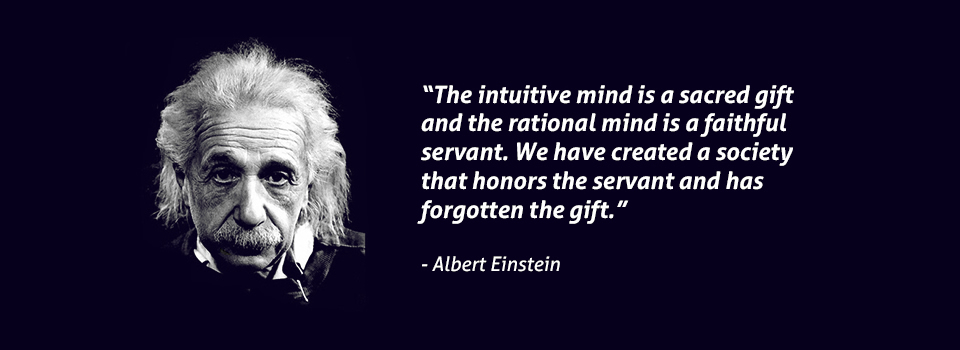
One faculty that is critical to spiritual growth is neglected, and then disabled, along the scientology route. In my view it is at the heart of the decline and reversal noted above. That is intuition. When I use the term intuition I use it in its broadest possible sense. That includes what the world at large considers extra sensory perception (including presentiment) and cognition and what Scientologists have referred to as ‘OT abilities.’
It has been said that the sixth sense could be considered conscience and the seventh sense intuition. I think that paradigm makes a lot of sense and have found it workable in practice. If one abides and nurtures a healthy conscience, attention and awareness is cumulatively freed to perceive and explore greater horizons. That includes those horizons that are not accessible to the traditional five senses; but are visible through intuition. In Scientology, once the aforementioned, dictated abilities are attained (and even during the quest), one is required to forfeit his conscience. I covered how that occurs in the books What Is Wrong With Scientology? and Memoirs of a Scientology Warrior. I cover it in greater detail in A Course on Graduating From Scientology, and suggest means for not only recovering conscience but also rising to the level of intuition.
Initially, intuitive powers are largely ignored in Scientology. As much as Hubbard at times preached the value of pursuing positive gain rather than negative gain (e.g. mid-fifties Ability Congress, Freedom Congress, etc) the scientology bridge ultimately focused on virtually nothing but attempting to remove the negative. Hubbard went so far to definitively announcing a ‘law’ back then that if one focused on disability he would ultimately get more disability and if he focused on ability he would get more ability, and then constructed the entire bridge in defiance of that law. In scientology one’s attention is focused on removing disabilities. One begins his auditing with lengthy sessions defining Dianetics and Scientology constructs. He learns early on that nothing proceeds unless the simple ohm meter (the emeter) with its mechanical yes/no answers green lights it. Attention is focused so as to detect the negative, that which is said to be foreign to the being’s natural state. So focused, the meter ultimately proves there is no end to the negative gain quest (reacting as it does to thought’s or intention’s interaction with the physical body). A number of provisions are enforced to make the constructs real. For example, along the way, if one does not think in pictures, he is treated as a special aberrant case in need of remedies that will get him to think by creating pictures. Then hundreds of hours can be spent auditing out the now-considered malady of thinking in mental image pictures. Or, if a person does not originate incidents from past lives, again he is treated as a special case and subjected to special remedies. Those include running incidents from movies the person may have seen. It even encourages the running of imagination as reality until such time that the person believes that imagination is in fact reality.
Exacerbating matters is scientology’s considerable thought policing that trains a person to rein in intuition. For example, the scientologist is trained to understand that any negative or ‘unkind’ thought he or she might entertain about L. Ron Hubbard or his appointed scientology ecclesiastics is the result of undisclosed crimes the thinker has committed or deeply seated evil intentions he or she harbors. That results in lengthy, traumatic, and very expensive interrogations on the e-meter to remedy the ‘cause’ of such intuition.
By elevating the emeter above judgment and understanding, the two-value logic construct is cemented in place. The all-knowing meter, being a two-valued, binary (charged or uncharged?) device guarantees that.
L. Ron Hubbard once preached against developing meter dependency. I think he understood when he did so that the last thing one wanted to do in search of greater spiritual ability was to synchronize one’s psyche against a crude electronic instrument. But, like with so much in Scientology, he also preached the precise opposite. For example, in 1978 – his self-proclaimed year of greatest technical breakthroughs – he ordered hundreds of long-time, dedicated Sea Org staff to hard labor concentration camps when the meter determined, in most cases against obvious available evidence, they were anti-social personalities unknowingly out to sabotage Ron Hubbard. In the early eighties he instituted a rundown – and demanded its application to all senior scientology ecclesiastics – to conform not only intuitive perception, but perception seen with the naked eye or heard with the ear (see, The ‘Truth’ Rundown). Again, we run into that super-charged word as the only one that can accurately describe the result of yet another scientology dichotomy, cognitive dissonance.
Some of the faculty of intuition can be brought out in the solo auditing process. But, for the most part it is lost by losing reality for the construct while engaging in continuous, active thought stopping to conform with scientology’s thought policing. Should the practitioner even consider the construct as construct, intense thought patrolling (as summarized above) is employed to correct him. What is never permitted to be recognized (which an unmolested or nurtured intuition would easily perceive) is that it is the process of exercising intention across distance – and communicating telepathically – that hones intuitive powers. It is not that which one focuses on, extends intention toward, and communicates with that does the trick. When the construct is implanted as reality – and it is with more force than any Christian or Muslim sect – the scientologist becomes to greater or lesser degree forever the effect of that construct. Again, the meter consistently proves the construct as reality. As a result the upper OT levels can become the route to slavish compliance to the perceptions and the guiding laws of the physical universe. More on this in a Course on Graduating from scientology, and possibly later posts.
There are a lot of benefits to be had from increasing focus and power of intention as I have acknowledged in this essay. The question I pose is, at the end of the day is the effort worth the cost in scientology? For many, they consider that it is. Provided those who fit into that category respect the rights of others not similarly inclined they have nothing to fear from me. I have spent my entire adult life working to guarantee their right to continue along that path. But, now my attention and intention is directed toward working with those who intuit that there are in fact broader horizons than Scientology permits exploration of.

More than thirty years of research has demonstrated rather conclusively that the average human being when connected to a galvanic skin response detection device (generic name for a Hubbard Electro-psychometer) routinely registers presentiment of about five seconds. That is, the meter reads on average 5 second prior to the subject being provided with a concept to respond to. This research has been performed on people taken off the street, with no previous psychic or spiritual training or study. It has been conducted applying exacting scientific standards.
What do you reckon the implications of these findings are to someone who has received hundreds of hours of standard Scientology auditing? That is, a process in which the practitioner is only permitted to address those concepts or incidents that react on the meter only at the precise end of the major thought as expressed in words by the auditor.
A few books off the top of my head where the referred to research is discussed:
The Field by Linda McTaggart
The Intention Experiment by Linda McTaggart
The End of Suffering by Russell Targ and J.J. Hurtak
Entangled Minds by Dean Radin
references:
By now, some Scientologists might have suspected that I am setting the stage to redirect them from following L. Ron Hubbard to following David R. Hawkins. In fact, while my third recommended reading assignment is Hawkins’ Power vs. Force, I would suggest to people at the outset not to latch onto Hawkins as they once latched onto Hubbard.
While Hawkins simply and eloquently describes states of consciousness above and beyond those contemplated in scientology (i.e. non-duality) a study of his arc of evolution finds him paralleling Hubbard in certain limiting senses. Both found workability in utilizing simple true/false detectors of energy connected with thought. Hubbard’s of course was the e-meter. Hawkins’ was the use of applied kinesiology. Both chartered and described the realms of higher states of awareness and consciousness discoverable by disciplined utilization of those thought-energy tools. On the other hand, both became so enamored with the efficacy of their tools that they lost the plot. First, by buying into the infallibility of their chosen mechanics, they in some ways dragged spirit/life down to the mechanics they used to explore it. Second, by overvaluing the adoration that the workability of their paths engendered, they succumbed to the seduction of guru status and the debilitating judgmentalism such positions breed. In a word, both ultimately eschewed the aforementioned lesson of the Tao that permitted them to discover what made them so popular in the first place. Power vs. Force is a very good read because it betrays little of those ultimate Hawkins failings – aside from the absolutist terms with which he promotes kinesiology.
A signal, critical difference between Hubbard and Hawkins is that the former attempted to force the world to accept his ideas and created a slave cult to accomplish that. Hubbard sought to command whereas Hawkins sought to teach.
Hawkins is recommended as a good first exercise in comparing scientology to data of comparable magnitude. You are likely to see independent validations of some core scientology principles and practices. You are also liable to begin to see the limitations of one’s scientology-controlled thinking. Power vs. Force can at once reinforce what of value one may have gotten from his scientology experience while piquing interest in other potential horizons beyond it. The latter are written about in a modern, mysticism-free manner in Power vs Force.
Another important distinction between Hubbard and Hawkins that makes study of the latter worthwhile for the scientologist is that Hawkins recognized – as does the traditional eastern wisdom I repeatedly suggest people devote some study to – the crippling effects of clinging to personal identity; ego. Power vs. Force also recognizes the value of graduating from constructs, as summarized here:
In overview, we can see that from time immemorial, man has tried to make sense of the enormous complexity and frequent unpredictability of human behavior. A multitude of systems has been constructed to try to make that which is incomprehensible comprehensible. To ‘make sense’ has ordinarily meant to be definable in terms that are linear – logical and rational. But the process, and therefore the experience, of life itself, is organic – that is to say, nonlinear by definition. This is the source of man’s inescapable intellectual frustration.
It is a lesson lost by many who have attempted to bottle and market the magical animation agent called ‘life.’ The most famous warning about that trap was summed up in one now-famous saying by Hubbard’s perhaps most important influence, General Semantics founder Alfred Korzybski, ‘the map is not the territory.’ Eastern wisdom has been communicating that in various ways for millennia. More recently, advanced theoretical physics is validating it as demonstrable. It is my observation that Scientology, applied exclusively as it requires itself to be applied, not only confuses the map for the territory, it has a tendency to convert the territory into the map in the follower’s mind.
In this book I am sharing my own journey toward recognition of the difference between map and territory and how I believe that that recognition can lead to broader spiritual horizons. I am fully cognizant of the fact that there are many people who are more intelligent or more spiritually attuned than me. What I see that I have to contribute to the mix is not necessarily wisdom or enlightenment, but instead the willingness to explore and communicate what a lot of Scientologists and former Scientologists have intuited but haven’t been willing or able to follow through with overtly. Therefore, it is quite likely that at various points along the line you might find my assistance has served its purpose and lose interest in continuing to follow this particular trail of exploration. It is after all only a map thus has served its purpose once someone is out of the ditch and heading in the direction he wants to go.
I think it is possible that by simply reading and contemplating the three recommendations that I have made in this introduction any individual is capable of graduating from Scientology in a positive sense. That is, recognizing its map/construct nature, what one attained from it, and where one might turn to expand on whatever level of consciousness or awareness he or she got from it. It might also occur at any given later juncture along the away. The sooner one finds that point of departure – hopefully with a fresh, curious outlook – the better as far as I am concerned.


 Moving On Up a Little Higher