
Author Archives: Mark C. Rathbun

Scientology and Psychiatry

We concluded the last post here, Scientology and Misogyny, with the following words:

Regardless, there is little question that the church of Scientology and its 30-year-tenured supreme leader David Miscavige are so misogynist as to qualify as anachronistic, if not outside of the law and boundaries of common societal mores on the subject of the sexes.  We will shed more light on this subject over the next several days.

Now, let’s address some facts.

Lori Hodgson visited with us in April 2011.  She was there on 18 April when the Squirrelbusters (SQBs) first arrived.   I had already just learned quite a bit about the leaders of the original SQB crew prior to their arrival. That is because one of the reasons for Lori’s visit was to heal from the terror they had already individually and collectively visited upon Lori.  I was going to publish this article while Lori was with us, but we held off because Lori considered it might not help at that time in her ongoing efforts to reunite with her two children that had recently been estranged from her.  We both agree that publication is now appropriate.

Hearing Lori’s story in full reminded me quite a bit of the Clint Eastwood directed movie Changeling. Eastwood accurately and brutally depicts early/mid 20th Century psychiatry used as a corrupt, political tool by the powerful and greedy. The movie is based on a true story.  Watching it a second time, and comparing it against what Lori and others have been subjected to by the church of Scientology made me recognize that Scientology has come full circle. In some ways it has become worse than that which it so blindly and aggressively resisted for so long: 1950’s institutional psychiatry.

Lori Hodgson did not have her family knocked apart by random, unfortunate circumstances.  She was subjected to Black Dianetics in the worst sense of the word, including Pain, Drug and Hypnosis techniques.   It was carefully planned, artfully and then overtly and quite intentionally executed.

Two key characters in this story were participants on the bizarre raid on my home conducted on April 18th 2011 (which raids continued unabated daily for 199 days), see Squirrelbusters: Day One.  Mark Warlick, the silent one, with the camera at the bottom of the stairs, was the Director of Special Affairs Los Gatos Scientology Organization that day. John Allender was the gang leader – a go-to OSA (Office of Special Affairs –the dirty tricks and propaganda arm of corporate Scientology) field operative.  Allender’s ‘security rating’ as an OSA operative was certified by Warlick with these words, ‘I trust him with my life.’

Lori’s former husband is a man by the name of Jim Leake.  He is pals with Allender and Warlick, mainly by virtue of being a good, reliable, ‘OSA-volunteering’ Scientologist in the San Jose area. John Allender’s wife Lynda – as “Senior Case Supervisor” was overseeing Lori’s Case Supervisor (the Scientology authority who closely supervises auditing sessions, including the intimate states of her client’s minds) through much of her “auditing” in the church.

These characters – and others – conspired over three years to steal Lori’s daughter and son, protect a dead beat dad (whom many states prosecute and jail for extended periods of time), and intimidate so as to obstruct Lori from exercising her legal rights to remedy the injustices.  All the while they used Scientology ‘philosophy’ and ‘technology’ to cave her in in an effort to make her think it was she that was lacking spiritually and mentally in demanding that truth and justice prevail. Just as institutional psychiatry was used in dealing with the woman portrayed by Angelina Jolie in Changeling.

In late 2008 – while in the middle of her Dianetics auditing program with the Church of Scientology (as supervised by Lynda Allender), Lori required invasive knee surgery.   The first surgery was a gross case of medical malpractice.   The problem that was supposed to be cured was exacerbated, leaving Lori crippled and in chronic pain.  But Lori was discouraged from seeking redress, since the  doctor was a renowned surgeon whose former wife and two kids were on staff at Los Gatos org.   He was known not to be too happy with that state of affairs and apparently the church didn’t want that sleeping dog disturbed.  Lori had the first surgery corrected in 2009 – which involved extremely intense work to remove the previous surgical product and replace it properly.   Both surgeries necessitated Lori taking pain killers over extended periods.

While Lori was being hooked up to IVs with pain killing drugs in preparation for the  (first) extensive knee surgery, her former husband Jim Leake was frantically attempting to solve his several year old potential criminal prosecution for violation of dead beat dad statutes.  Jim had been in continual arrears on child support for the daughter and son Lori had born and raised, since shortly after 2006 (Lori divorced Jim in 2002.) Jim was creating that debt while continually pitching in at every insistence by the likes of the Allenders and Warlick and their Scientology brethren.  Jim’s solution fit hand in glove with the intentions of the Scientology organization.  And pursuant to the Scientology ethics system, since Jim’s aims paralleled the Scientology organization interests, he would be backed by the full power of the organization and Lori would be treated as fair game for personal destruction.

Through brainwashing, coercion and fear tactics Jim was seeking to get Lori’s children into the Sea Org, before they developed the maturity to evaluate right and wrong for themselves. In this scenario Scientology would win netting two new second generation Scientologists for a lifetime of unpaid labor, and Jim would win, ‘because how is Lori going to demand child support when he’s deposited both of their children (without a proper education) into Scientology’s ‘religious’ order?’

Before Lori’s surgery ordeal Jim and the Scientology org had already accomplished this with Lori’s then-15 year old daughter Jessica.  One day she announced to her mother that she would never go to school again. That was when Jessica was an honor student and was clearly enjoying her traditional education.  It was also after high pressure recruitment sessions Jim arranged with Los Gatos org staff.   After 6 months of fighting this Lori finally agreed that her daughter could go to a Scientology school to finish High School.  Little did she know that recruiters had arranged for, and executed, her daughter to ‘graduate’ in 3 months at the age of 16 and signed a five-year Scientology staff contract.  That same year her daughter got home sick while on full-time study at Flag and came home to San Jose; she was straddled with a 12-13,000 dollar debt at age 16.

While Lori was flat on her back recovering from (her 1st) surgery, Jim took Lori’s 15 year old son Jeremy to a three hour high-pressure session with Sea Org recruiters.  Following the event, Jim and Scientology recruiters sent Jeremy to Lori’s house demanding that she sign away her parental rights so that he could join the Sea Org.  While Lori was recovering, in intense pain and while on heavy pain killers, Jim and the recruiters kept sending Jeremy after Lori pestering her to sign the papers.  Finally, a group of Sea Org recruiters arrived unannounced at Lori’s home, and while she was in excruciating pain in the bathroom, they pounded on her front door shouting and demanding entry (much like the Allender crew did at my home on April 18th 2011).  Lori attempted to protest this activity, but her own auditor – the one working under the Snr C/S Lynda Allender – persuaded her to shut up. Lori continued to protest, but Lynda Allender (Senior C/S) ignored her pleas and ordered her to focus on her ‘Scientology assists.’

Just two weeks before the second surgery Lori finally succumbed to the collective pressure and complied with demands that she sign parental consent for Jeremy to join the Sea Org.

After the messy, complicated second knee surgery, on day two in recovery at the hospital, Lori’s daughter was sent in to tell her mother ‘good bye’, informing she was leaving for the Sea Organization (to fulfill a billion year contract she had signed).

Jeremy  lasted only 7 months in the Sea Org.  He cried many nights to come home, but never was allowed to tell his mom.  He finally did come home.  But when she tried to remedy whatever he had experienced in the Sea Org that caused him so much terror and grief, she was rebuffed because Jeremy was forced to sign a non-disclosure bond that threatened him with a $3 million fine if he told his mother anything about his Sea Org experience.

Jessica lasted even less time in the Sea Org.

After recovering, Lori attempted to pursue Jim Leake for his nearly two years of delinquent child support payments.  The Director of Special Affairs Mark Warlick stalled her from going to court using Scientology policy against ‘suing’ fellow Scientologists as authority. Finally, in 2010 Lori began to educate herself on the Black Dianetics nature of the Scientologist church.  She traveled to Corpus Christi for a few day visit with Carol Kramer, Mosey and myself.   She resolved to return to utilize Dianetics and Scientology techniques to remedy her engrammic Scientology church experiences.
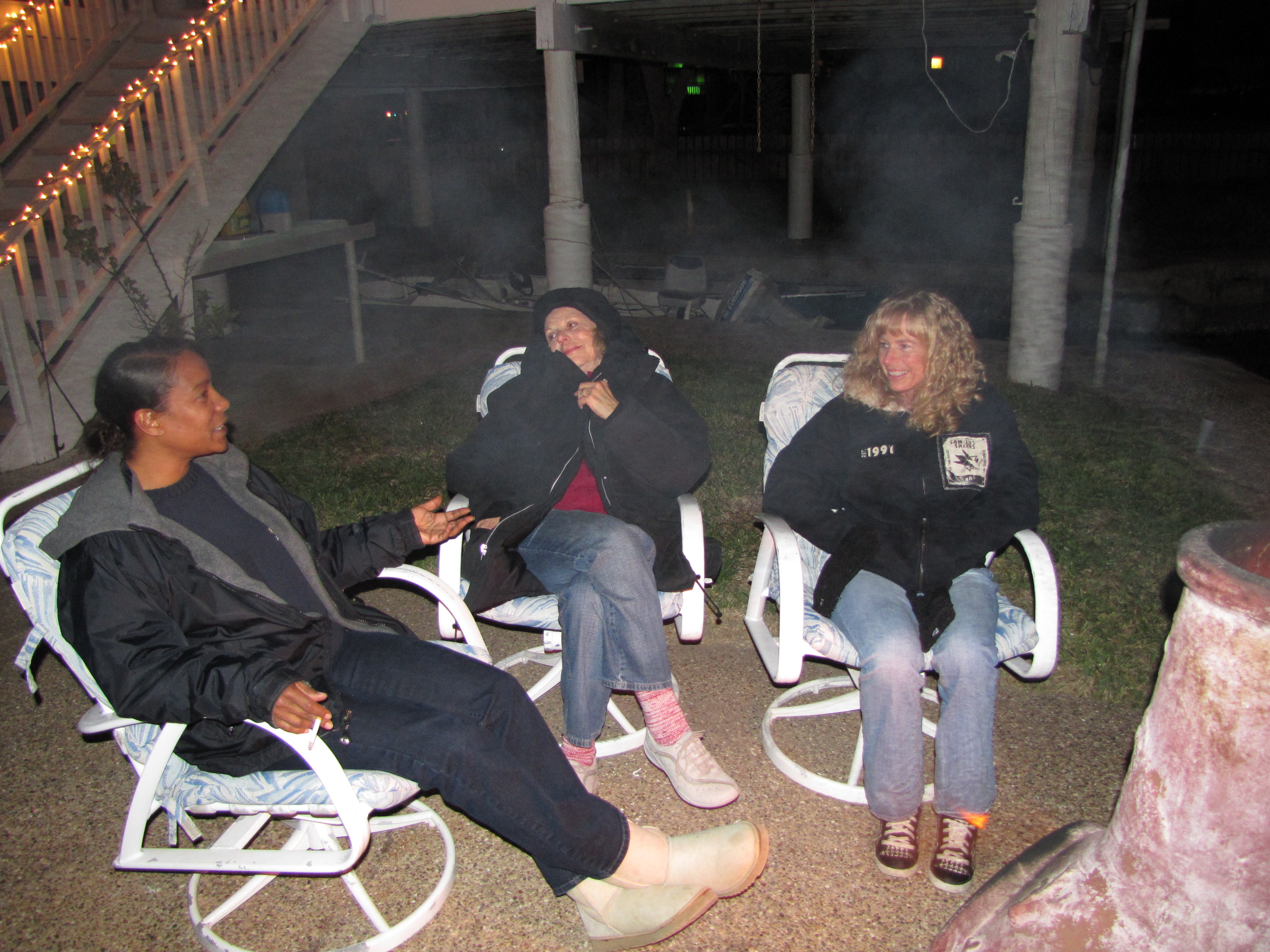
Three Camp Fire Girls Dishin'

Lori with Monique and Carol at Casablanca

Within a day of her return to San Jose Lori was stalked, assaulted, and threatened by John Allender.   Allender hid in the (parking lot) by her office and spied on her for hours. When he saw her leave for the day and that she was alone, he assaulted her and threatened her in the parking lot, asking ‘how do you like beatings?’

Lori’s daughter Jessica and son Jeremy were then put into long, mind control sessions with Rick Melrose at the San Jose Mission.  Rick with the help of Jim Leake, convinced Jessica and Jeremy to disconnect from their mother.  They also convinced them that Lori was “imagining” that John Allender had assaulted her, that there was something wrong mentally with Lori. Jeremy was so viciously brainwashed that he coolly looked Lori in the eye and told her that it was her reactive mind telling her that Allender had assaulted her. Taking the pre-1950s psychiatric abuse of Changeling to a whole new level, not only the ‘practitioners’, but the child of the target was recruited  to convince his truth-telling mother that she was crazy.

On the morning of 18 April 2011, Lori and I had a long counseling session where we addressed all of the above – attempting to mitigate and repair the pain and suffering she had been subjected to.   When we broke for lunch, the Scientology team of Allender, Warlick and two other thugs with cameras – dressed out of some ugly, nightmarish implant – stormed my home.   The very day of the raid Lori received papers from Jim Leake’s attorney – clearly paid for by the church or at its direction – since Leake cannot even see fit to pay for his children’s upbringing.  The papers announced Jim was going to vigorously oppose Lori’s attempt to have her rights vindicated in court.   The four creeps being sent to Corpus Christi was clearly timed to prevent Lori’s personal recovery and also to intimidate her into dropping charges that were pending – an attempt to cut her  trip short so that she would have to return home to continue her legal battle against dead beat Leake.

Many people have speculated why I momentarily appeared to lose my temper during this incident and rip the microphone out of Allender’s hand when I learned his identity.   Perhaps this sheds more light on the context.  Less than ten minutes earlier Lori had run through Allender’s previous stalking and threats leveled against her in San Jose. Lori was frighteningly watching and listening to this entire incident as it was happening right outside her window in the downstairs apartment just behind me in the video.

Lori pursued the court action to remedy the law mandated 60% child custody Lori was deprived of by Scientology and Leake’s causing Jeremy and Jessica to disconnect from their mother.  Lori also sought to raise the issue of her son being made to sign a $3 million gag order upon leaving the Sea Org. Scientology and Leake ultimately dragged out the war against Lori until after her son Jeremy turned 18.  While Lori was awarded financial restitution, by the time Jeremy turned eighteen the court was powerless to do anything about the forced disconnection of her children.

To appreciate how Scientology has come to the complete dramatization of becoming that which it so vigorously resisted, please watch the movie Changeling.  Please review the facts here.  Please confront what has happened to your erstwhile “church.” It has apparently become an institution resembling the mid 20th century state institutional psychiatry it spends millions railing against. Wake up.

Scientology and Misogyny

Misogyny is described in Wikipedia as follows:

Misogyny /mɪ’sɒdʒɪni/ is the hatred or dislike of women or girls. Misogyny can be manifested in numerous ways, including sexual discrimination, denigration of women, violence against women, and sexual objectification of women. Misogyny has been characterised as a prominent feature of the mythologies of the ancient world as well as various religions. In addition, many influential Western philosophers have been described as misogynistic.

Misogyny within Scientology has been so prelavent that Wikipedia’s entry on the former includes a section on the latter:

Scientology

See also: Scientology and marriage

L. Ron Hubbard wrote the following passages in his 1965 book Scientology: A New Slant on Life:

“A society in which women are taught anything but the management of a family, the care of men, and the creation of the future generation is a society which is on its way out.”

“The historian can peg the point where a society begins its sharpest decline at the instant when women begin to take part, on an equal footing with men, in political and business affairs, since this means that the men are decadent and the women are no longer women. This is not a sermon on the role or position of women; it is a statement of bald and basic fact.”

These have been criticised by Alan Scherstuhl of The Village Voice as expressions of hatred towards women. However, Baylor University professor Dr. J. Gordon Melton has written that Hubbard disregarded and abrogated much of his earlier views about women, which Melton views as merely echos of common prejudices at the time. Melton has also stated that the Church of Scientology welcomes both genders equally at all levels from leadership positions to auditing and so on since Scientologists view people as spiritual beings.

Whether misogynist views are implanted along with Scientology indoctrination is an interesting question.  It would seem they are – at least on some level – for those who take the fundamentalist position that Ron is ‘Source’, and it is illegal and punishable to state or infer or consider that anything he uttered or wrote is ‘background’, ‘no longer in use’, or ‘historical’.

Regardless, there is little question that the church of Scientology and its 30-year-tenured supreme leader David Miscavige are so misogynist in practice as to qualify as anachronistic, if not outside of the law and boundaries of common societal mores on the subject of the sexes.  We will shed more light on that subject in the near future.

Ability

Related posts:

What We Do: Part 1

Graduating Scientology (What We Do: Part Two)

What We Do: Part Three

Ability

In my estimation one of L. Ron Hubbard’s most important contributions to spiritual psychotherapy was his guided approach to witnessing.  The Scientology Grades were for the most part developed in Ron’s attempt to build a smoother, more sure-fire route to ‘Clear’, which he defined as the ‘unrepressed, self-determined’ state of being that is not continuing to unwittingly create his or her own mental barriers.  Engram running of the early fifties was a grinding, messy affair.  Notwithstanding ample claims otherwise in Scientology publications and lectures, the results were inconsistent and many times catastrophic.  Fifteen years of experimentation and research led to the introduction of the Grade Chart.  It was the culmination of years of research on how to achieve ‘Clear’ more rapidly and certainly than with the uncertain, hit-and-miss Dianetics engram running method.

As Ron developed each Scientology grade, along the line he claimed that each, individually, was the answer to attaining Clear, quite independent of one another.  For example, Grade 0 is the Communication grade.   The book that serves as the backbone of Grade 0 technology – and the auditing (communication) process itself – is called Dianetics 55!   The book explains the entire universe within the sole construct of communication.   It posits that if one were perfectly ‘cleared’ on the subject of communication one would have no ‘case’ (the cumulative aberration of an individual) and thus would not only be Clear, but also OT (Operating Thetan, later ‘higher’ postulated state of being).

It is the same for Grade 1 (problems), Grade 2 (hostilities and sufferings), Grade 3 (change), and Grade 4 (fixed conditions and ability to do new things).   The statement of those goals, intentions, and results at each Grade were memorialized in his lectures along the way.  And at every level you can find Ron postulating – in fact, stating as factual certainty in his own inimitable style – that that grade is the answer to Clear and beyond.

During much of that research period Ron included a caveat about each of those levels being the answer in and of itself.  That is, that if an auditor were addressing the recipient-client from the perspective and with the intention of improving ability his postulated Clear and beyond could and would occur.  Addressing ability was starkly in contrast to the approach in Dianetics, which attacked disabilities.   This is well covered in the Ability Congress lectures.  There, Ron pronounces as ‘law’ that if an auditor approaches a client with the attitude of improving ability, he will get more ability. If he focuses on addressing disability, he will cause more disability.

As was most often the case in the history of Dianetics and Scientology research, the survival considerations of fighting enemies and having the wherewithal to do so and carry on affected the ability or willingness to test out the hypotheses and claims Ron made along the way.  It was a fast-moving train constantly receiving and firing volleys, while attempting to lay ever-more instant and consistent track.  Critics of Scientology and Hubbard will give more nefarious, ill-intentioned reasons for that omission of testing.  The reason why is of little import, because regardless of causation, the fact remains.

Along the way, the once stable foundation of the priority of addressing ability as opposed to disability was lost.  I have found through 35 years of practice that this loss was fatal.  Focusing on disability results in a never-ending ‘bridge’ requiring cult-like devotion and ultimately creating regression.  Focusing on ability brings greater ability and determinism.   There is one thing that perhaps best distinguishes how we practice from others we are aware of.  Our first stable foundation is that we audit and train toward ability.

Graduating Scientology

A lot of what I do has come to be characterized by my wife and me as assisting folks to graduate above Scientology.   It is somewhat of a unique notion.  In fact, the vast majority of people who devoted much time to Scientology ultimately go through the graduation process;  reconciling what they learned and gained, differentiating it from the entrapment mechanisms involved, and finding ways to integrate with society, and to evolve and transcend as a person.  As far as Scientology-understanding assistance along that route, resources have been slim.

To date there has really only been a couple of paths for Scientologists and ex-Scientologists; at least ones that are assisted by Scientologists or ex-Scientologists who understand something about the subject.  Both avenues are of the least resistance variety; the easy, least effective ways that ultimately don’t lead toward graduation.

First, one can cling to his firmly held Scientology religious beliefs and continue with the installed cognitive dissonance that entails.  He or she can be guided to pretend that it is all ‘over-there’ in the church and play the ‘I am the resurrection of the real Scientology’ game.   That ultimately leads to a sort of bitter, secluded ‘victorious Confederate soldier’ megalomania and melancholy.  Second, one can be guided to redirect the implanted Scientology need for an enemy and spend years in a state of suspended enturbulation, senselessly flailing at the church or Scientology itself.  The latter route leads to much the same state of mind and consciousness as the former.

I think both routes are infected by perhaps the most insidious virus one is inoculated with in participating in Scientology.   That is the need to have an enemy.  I have written about this before, e.g. Cults, Enemies and Shadows.  It is a decidedly ‘effect’ state of mind; a continual restimulation of a paranoia about the external ‘true’ cause of one’s travails.  It does not lead to growth, evolution and transcendence in any sense.  It is like remaining in High School year after year, failing to evolve past the angst of adolescence.

There has been a tremendous amount of research done on stages of human growth; cognitive, psychological, moral and more.   This is research done by way of learning more about biology, and observing and interviewing tens of thousands of people for over a century.   It is not ivory tower ‘psych’ chatter.   James Fowler thoroughly studied this huge body of work and spent many years observing an entirely new category of development consistent with those already done on moral, biological, and cognitive bases.  His work was on the stages of development of faith.  Please read this excerpt from his book on the subject,  Stages of Faith, concerning the observed stage of adolescence:

New expectations, qualitatively different disciplines and a host of difficult decisions are the requirements with which societies greet the now more womanly or manly adolescent. In trying to meet and fulfill these requisites youth will call on the available and personally resonant ideological resources of their environments, particularly those that are embodied in charismatic and convincing leaders.  They will seek sponsoring groups and figures and will appoint otherwise well-meaning persons as temporary enemies over against whom their identities may be clarified.  They may band together in tight cliques, overemphasizing some relatively trivial commonality as a symbol of shared identity.  In this cliquishness they can be quite cruel as they exclude those who do not share this common element.

The Scientologist and ex-Scientologist adolescent pack mentality can be graduated from.  It opens up to view a wonderful horizon of possibilities and futures.  I think first and foremost it entails getting over the implanted need for enemies.

Emotions III: The Tone Scale

Someone posted here once a lecture reference where L. Ron Hubbard pronounced that ‘action’ and ‘games’, were the places to aim for in terms of chronic emotion or state of consciousness (see Real Emotions for how Scientology tends to collapse the two ideas).  The idea was that the top of the scale ‘serenity of beingness’ was far too boring for a being to stay with for very long. For those who made those ‘emotions’ their chronic targets, or their aspired to states of consciousness, here is something to think about.  Games and Action are not emotions.  They are activities.  One could and does engage in ‘games’ and ‘action’ at every level of emotion. The next higher ‘emotion’ on the Scientology emotional tone scale, Postulates, too is not an emotion – and like ‘games’ and ‘action’ is engaged in during all manner of actual emotion.  While ‘Serenity’ may well be an emotion, ‘serenity of beingness’ is probably something else entirely (more on that at another time).  Perhaps the placement of activities on the emotional tone scale contributed to some of the confusion that occurs in Scientology with respect to the role and purpose and worth of emotion.

This begs the question, are there emotions higher than exhilaration (perhaps the highest Scientology tone scale position that is fairly sure to be an emotion)?  I think it is a worthwhile exercise for people to work out for themselves how the emotional tone scale should or could or can be logically and intuitively seen to be.  That is particularly so for those who have set their life goals around the achievement of the non-emotions placed at the top of the Scientology tone scale. It can be a liberating exercise.  I have done a lot of work on it myself – by self-observation and observation of others.  I share some of my notes on it below.  This sharing is not for the purposes of indoctrinating or selling an idea.  Instead it is provided in order to stimulate thought and conversation and input.  The plain type items accompanied by numbers are from the original Hubbard Tone Scale In Full.  The italicized typed items are tones on the existing scale that I question as being emotions in the first place (as noted above).  The bold-faced, italicized entries are emotions I added by observation in their relative positions to the existing Tone Scale In Full.


Bliss, Pan-equilibrium (Non-Duality)

Serenity, equilibrium (Justice)

40.0  Serenity of  Beingness                                          Know

Compassion (Responsibility)

Care  (Nurturing)

Empathy (Transcendence of ego/pan-emotion)

Appreciation (Acknowledgment)

Release (Letting go)

30.0  Postulates                                                                Not Know

22.0  Games                                                                       Know About

20.0  Action                                                                         Look

8      Exhilaration                                                              Plus Emotion

6      Aesthetics

4      Enthusiasm

3.5  Cheerfulness

3.3  Strong Interest

3.0  Conservatism

2.9  Mild Interest

2.8  Contented

2.6  Disinterested

2.5  Boredom

2.4  Monotony

Emotions II: Play Acting Scientologists

Scientology culture is recognizable by its collective, synthetic ‘cheerful’  or ‘enthusiastic’ emotional tone.  Scientologists learn to put on a happy face.  If they are seen without one, a fellow Scientologist considers it his duty to ‘handle’ it. And that primarily means making the person mentally deal with the life situation causing the lower emotion so that he can easily mentally cope with putting on a happy face in spite of it.  In a Scientology group one is expected to act happy.  To display any emotion less than that results in Scientologists almost instinctively interceding with a person’s psyche to remedy the perceived problem.  A Scientologist learns eventually to convincingly act happy all the time, even when he or she is feeling deep sorrow, a sense of devastating loss, or is suffering pangs of conscience.

Scientologists will bridle at the notion they are taught to play act through life.  But, the technology they are applying day in and day out is plain:

‘Force yourself to smile and you’ll soon stop frowning.  Force yourself to laugh and you’ll soon find something to laugh about.  Wax enthusiastic and you’ll very soon feel so.  A being causes his own feelings.’  – L. Ron Hubbard 25 August 1982

If you read Memoirs of a Scientology Warrior (Amazon Books, 2013) you will get a fairly comprehensive picture of the mood of the Scientology community that Ron was addressing with this bulletin, and the reasons for that tone.   That includes the mood that Ron himself was in.

I think that if you look at it objectively you cannot help but see the effects of a culture en masse adopting the stable datum that emotion is something to create like play acting.  That objective look has prompted some to reckon Scientology culture as resembling those communities depicted in the movies The Stepford Wives and The Truman Show.  How else could otherwise upstanding-seeming citizens blissfully ignore wholesale human rights violations happening at their church’s headquarters, the regular disappearing of church public figures, the forsaking of long-time associates and even family on the arbitrary order of one’s church, the countenancing of extreme methods of harassment directed at anyone who expresses the slightest disagreement with the Scientology way, etc, ad infinitum.  If you believe this only applies to the corporate church community you have got a serious case of denial – maybe even the Stepford/Truman strain.

There is another, accurate, word to describe this phenomenon of manipulating one’s own emotions.  It is called ‘acting.’

As in, act, from New Oxford American dictionary: 2. Behave in the way specified, and  5. Peform a fictional role in a play, movie, or television production.

I have news.  One must for sure act in order to attain desirable emotion, such as those concomitant with ‘happiness.’   But, Scientologists  – notwithstanding all their literalness with exact, precise definitions of terms – are given  and tend to thus dramatize the wrong definition of act.

Try, definition 1, Take action; do something.

Viktor Frankl can ‘splain better than I can:

Normally, pleasure is never the goal of human strivings but rather is, and must remain, an effect, more specifically, the side effect of attaining a goal.  Attaining the goal constitutes a reason for being happy.  In other words, if there is a reason for happiness, happiness ensues, automatically and spontaneously, as it were.  And that is why one need not pursue happiness, one need not care for it once there is a reason for it.

–          Vitkor Frankl, The Will to Meaning

For those Scientologist still sufficiently brainwashed to refuse to consider the words of a psychiatrist – even one who survived three stints in Nazi concentrations camps and demonstrably walked the walk far more realistically than any Scientologist who ever breathed – maybe the following will resonate.   It is understood in the highest halls of academia as well as the streets of Brooklyn.  You gotta work hard to ‘be’ who you wanna ‘be.’   Wake up.  Perceive. Feel. Live.

Real Emotions

Somewhere along the way emotion was converted into equating with states or levels of consciousness in Scientology.  In the process emotion became a negative humanoid attribute, e.g. writing off any feeling or expression of emotion off as ‘human emotion and reaction’ or ‘h, e and r.’

Emotion and grades of awareness or consciousness are not the same thing.

Wikipedia gives a good definition for emotion that was no doubt contributed to by a number of interested people from a variety of religious, philosophical, scientific and educational backgrounds.  It is as follows:

In psychology and philosophy, emotion is a subjective, conscious experience that is characterized primarily by psychophysiological expressions, biological reactions, and mental states. Emotion is often associated and considered reciprocally influential with mood, temperament, personality, disposition, and motivation,as well as influenced by hormones and neurotransmitters such as dopamine, noradrenaline, serotonin, oxytocin, cortisol and GABA. Emotion is often the driving force behind motivation, positive or negative.

That definition is not inconsistent with Scientology definitions, even if it is far more comprehensive.

The last sentence bears some thought, ‘Emotion is often the driving force behind motivation, positive or negative.’    Carl Rogers has noted that emotion can serve as an important referent to deriving meaning.  For example, an issue that confronts you causes sadness.   In processing that emotion, it might inform your conscience and influence you to decide to do something worthy about the situation.  That in turn could result in your feeling some more pleasurable emotions.

If instead you used a mental trick to lift you out of sadness, you may well simply feel comfortable – in the short run – in forgetting that which made you sad.  Your conscience is bypassed in the equation; and the situation that perhaps legitimately engendered feelings of sadness remains unaddressed.   Would that be ethical?  Would that be pro-survival?  You’d have to think of examples of real situations and work it out for yourself.

Imagine habitually utilizing exercises that rose you from genuine emotions caused by real situations that confronted you.   What would ultimately happen to your conscience?   How real and worthy and meaningful a life would you wind up living?

Perhaps because emotion is mistaken for a level, grade, or state of consciousness in Scientology the culture tends to frown on having, demonstrating or processing emotions per se.  They certainly are not recognized as anything worthy of serving as a referent to deriving meaningful meaning.  Emotion instead becomes something to get out of, something to rise above, or something to manipulate in others.  Techniques abound in Scientology for achieving that.  Nothing wrong with such tools provided they are used wisely.  When I say wisely, I mean not done so habitually and consistently that one becomes emotionless.  In Scientology cultures, folks can become downright anti-emotional to the point where conscience is effectively forfeited.  That would seem to be a factor in Scientologists’ facile ability to turn their backs on loved ones, associates, family, and  friends; and even to proudly avow to never fear to hurt another in a just cause.

If you’ve been in Scientology culture for very long, I invite you to have and process for yourself some real emotion.  Don’t try to repress it, suppress it, avoid it, evade it, escape it, conquer it or ‘causatively’ rise above it.  Instead, feel it for all it is worth.  See for yourself whether sometimes emotion can inform your conscience and your decisions and lead to more rewarding and meaningful activity on your part.

What We Do, Part One

For some orientation to what I would like to over in this essay I begin with a passage from Chapter 25 Epilogue from Memoirs of a Scientology Warrior (Amazon Books, 2013):

     As has been ably reported by Janet Reitman in her book Inside Scientology (Houghton Mifflin, 2011) and by Lawrence Wright in his book Going Clear (Alfred A. Knopf, 2013), L. Ron Hubbard was a very capable marketing man. What they did not acknowledge as much, but did not totally discount, was Ron’s ability to solve problems – including those of the mind and spirit. Ron had a knack for finding out what was bothering people, putting together methods to address those things, and then selling those methods as services – the end-all that people just had to get their hands on.

     The Reitman and Wright books detailed how Ron was continually creating new rundowns, new levels and new packaging to keep the Scientology public enthused over the latest in the mind and spirit.  It was the formula that created continuing expansion of the Scientology empire during L. Ron Hubbard’s life.  A strong customer base was established and continually kept interested and buying as new, essential route-to-total-freedom items were rolled out.

     Because Ron so unequivocally mandated that only Ron could discover, create and memorialize mental and spiritual technology (the only stock-in-trade of the church of Scientology) upon Ron’s death the church’s expansion pattern also died.

     Consequently, David Miscavige took on an unenviable task when he was handed the reins of Scientology Inc.  And those reins were handed to him, whether begrudgingly or not, by Annie Tidman Broeker (Loyal Officer 2) when she sided with Miscavige against her then-husband (Loyal Officer 1) Pat Broeker. Miscavige had no choice but to radically change Scientology’s forty-year expansion pattern.

     The movement had been built and held together primarily through the promise and continual roll-out of new technology. Now Miscavige had to keep that movement going, but with no possibility of introducing new technology. For a while he seemed to have somewhat of a grasp of marketing, but all the marketing in the world could not keep an organization thriving when it had nothing new to sell. At least not an organization whose viability depended on continual emanation of new technology to sell. And by firm religious belief and church doctrine, he was powerless to create any new technology.

These facts – recognized by credible, outside observers and by insiders like myself – are at the heart of why Scientology (the whole package) is as dead as a door nail.  The promises are infinite while the delivery of them is impossible.

The first thing that probably distinguishes us from all others we are aware of who utilize some of the discoveries of Ron Hubbard is that we do not play – in any way, shape, fashion, or form – the baiting evaluation game that comes part and parcel with Scientology.  That is the incessant, overt and covert, game of continuous evaluations along the line of ‘the next roll out will really get you there’, ‘the next level will handle your problem’, ‘you need to act in this fashion so that you see the wisdom of taking your next step’, ‘you’ll understand that when you get to ______’, or any other of the pitches that were memorialized in unalterable, firm Scientology policy and mental technology throughout the years.

That most decidedly includes the insidious safety valve, bait-and-switch line ‘the reason it didn’t work for you was that it was corrupted by someone else, and now we’re going to give you the real thing’ as is so regularly chanted by the church and the shadow it casts, Scientology practitioners outside of the church.  The real thing is precisely what is described in the book passage above: the never-ending promises to the stairway to Heaven that demonstrably does not lead to Heaven.  It more often leads instead to the perfect cognitive storm: holding these two conflicting ideas counterpoised,  a) I have done everything Ron prescribed, so I know everything there is to know, and can never improve because I am already perfect – b) all the while colliding with the deep-down, suppressed self-recognition that the individual has become intolerant, arrogant, callous and miserable.

This find-the-ruin, bait-and-switch mentality is woven into the woof and warp of Scientology.  It gets played from initial marketing to the highest reaches of the bridge. It has always been, both inside the church and without, that those who play it best are sainted with being the most ‘On Source’ (with L. Ron Hubbard) Scientologists.

It also happens to be Ron’s first,  greatest  – and ultimately most fatal – departure from the technology he primarily borrowed from in creating Dianetics and Scientology: Rogerian client-centered psychotherapy.  The second the client is played – in any way, shape, fashion or form – by definition the process is no longer client centered.  Instead, it by definition becomes practitioner – or organization – centered. The road to restoration of self-determinism becomes paved with enforcement of obedient following.

Do I mean to say that Ron was a con?   Do I mean to say that everything he discovered or purported to discover was fraudulent?   No; as you shall see in further installments.  But, I am defining what it is we do and the first thing we do is stay true to the client-centered philosophy that is at the heart of – in fact, is the sine qua non of – all that is workable in Scientology.

Ishmael


Some folks have found my repeated reference to the Tao Te Ching to be puzzling.  Some Scientologists have simply used it to write me off as being lost. The Tao is such a radical departure from the ‘philosophy’ Scientologists learn and abide by – even while denying to themselves such adherence exists – that some dismiss it as philosophical gobbledygook.  I have commented on the polar nature of those philosophies (Scientology and the Tao) and noted it as an important reason to become acquainted with the Tao, e.g. The Tao of Scientology.

The fact of the matter is that a consistent construct in Scientology requires the adherent to mock up and act out the identity of conquerer.  For example, a Scientologist is taught to view the universe as an epic struggle of the spirit’s sole mission as the conquest of the physical universe.  Such a view can and often does, if not mitigated by deeper understandings, result in destruction of that which one programs oneself to conquest; not to mention the weakening or destruction of the ‘conquerer’ himself.

Many have recognized this on some level and have departed the church because of the dangerous environment such a philosophy ultimately creates.  Many of them spend years then applying an harmonic of this same warlike philosophy toward the church, ‘it is the church or current management that needs to be conquered.’  Others facilely write off the ‘conquest’ attitude as an attribute of church management and go off to apply what they call ‘real Scientology’ independently.   Inevitably, to the degree they avow to remain loyal to Scientology ‘philosophy’, those independents wind up playing the conquest game against one another.  It happened with the first independent movement in the eighties and the second one more recently.

To the extent one recognizes this mentality in himself he objectivizes it and can thus let it go.  An increase in equanimity and personal peace can ensue.  That which was useful and survival for someone in his or her Scientology experience can more easily and naturally be recognized and reinforced.  That which was of negative worth and non-survival can be recognized and let go of.

The continuing recommendation of the Tao as integral reading and understanding was meant to set this salutary evolution in progress.

But, I understand how ‘left field’ this recommendation can seem to those living the Scientology construct of ‘conquest of matter, energy, space and time’, ‘conquering the reactive mind’, ‘putting ethics in on the planet’, ‘gaining territory for Scientology’, etc.

I just read a book that may help to bridge the gap between the necessity-of-conquest think and learning to let go or living and letting live.  It communicates the essence of the Tao (without ever making any reference to it) in more modern terms.  It does so in an entertaining and currently-relevant fashion.   That book is Ishmael: An Adventure of the Mind and Spirit by Daniel Quinn.  It is a novel that tells a story in a creative, unique and interesting setting  – a story that is captivating in and of itself.  It explores some scientific, philosophic and religious constructs that Scientologists are taught early-on to discard in their entirety – the Bible and Evolution of Species.  In that regard, those who have bought into and scrupulously adhered to Hubbard’s wholesale rejection of such fields will learn a little something about perhaps the two most common poles of thought on this planet.  You don’t have to buy into either of those poles, but I bet you will never look at them (or those who believe in them) the same way.  You might recognize the parallels of both with Scientology philosophy and thus be more able to put Scientology and your experience with it in a sane and nurturing context. Maybe more importantly, you might begin to take a more realistic, informed view of the planet, humanity, and civilization and your participation in it.

My Practice

My practice is grounded in client-centered education techniques.  That is not because I sought to duplicate them.  Instead, I recently came to learn that the way I coach and counsel toward recovery and graduation from Scientology was discovered and written about long before I was born.  Reading of it helped me to improve what I was already doing.  Carl Rogers covered this approach in his book, On Becoming a Person, explaining how educational techniques logically evolve out of client-centered therapy.

That I gravitated in this direction during my own recovery and graduation should be no surprise, given the authoritarian, religious discipline all Scientologists studied under for so many years.  The client-centered approach is tailored to consulting the understanding of the client or student.  In that regard, it radically differs from Hubbard’s training approach that was memorialized as follows:

If you can’t graduate them with their good sense appealed to and their wisdom shining, graduate them in such a state of shock they’ll have nightmares if they contemplate squirreling (defined as departing one iota from the letter of what is taught).  – L. Ron Hubbard, Keeping Scientology Working

That learning philosophy was explained further in Hubbard’s highest level instructions (Class VIII course) wherein he told the most advanced Scientologists that humanity was incapable of being appealed to through understanding; and so, instead, it was their duty to command people and make them ‘obey.’   (See Memoirs of a Scientology Warrior, Amazon Books 2012)

Irrespective of the fact that much of the technology such methods sought to impart was geared towards bringing a person to self-determined understandings, that system of indoctrination ultimately implants fixed, subjective ideas about living, God and ultimate spiritual concerns.  At the end of the day, the methods place a glass ceiling on growth (in fact create regression) by means of enforced belief that curiosity and thirst for continuing education inherently stem from aberration.

It may well be that I was also influenced in the client-centered approach through my own earlier education, some of which was influenced by, or was even attempting to experiment in, Roger’s educational recommendations.  The middle school I attended was a fail-pass (no grade), choice of curriculum, self-scheduling format with emphasis on consulting students’ interests.  I also attended a semester of similar organization at University of California Santa Cruz.  I never knew until I read Rogers where these ideas came from.  Perhaps my Scientology study contributed to this leaning too, since I have noted in the post On Becoming A Person, Scientology’s central practice (auditing) is a modified, structuralized form of Rogerian client-centered therapy.  No matter what led to which along this road, it is interesting to note how what gets around comes around.

Having studied all of Scientology and a great deal on the subjects that led to its development (including their continued evolution while Scientology has remained static), a simple, workable rule of thumb has materialized for me.  That is, the degree to which Scientology departs from its client-centered philosophical and technical roots is proportional to the degree it harms rather than helps.  This in large part has become evident to me in helping people who were disappointed with their Scientology experience over the past five years.  Almost to a one, somewhere along the line each individual’s intent and purpose for engaging in Scientology in the first place were tampered with, rejected and replaced entirely by imposed intents and purposes.

Somewhere along the line in the Scientology experience the magic of the technology – each of its efficacious results marked by its adherence to its client-centered philosophic roots – is replaced by inculcation of the client rather than consultation and service of his or her needs, wants, aspirations and purposes.  Those goals do, and ought to if a positive evolution of awareness and ability is being achieved, change along the road.   But evolution in Scientology is geared solely toward achievement of goals that do not involve the client’s participation in establishing, except to the extent means are employed to obtain the client’s agreement to pursue them.  The attainment of those implanted goals turns out to be purely subjective – no matter how clothed in science its claims and promises are presented.   An objective examination of the result of those who pursue the implanted goals to their ends – no matter how convincing its achievers may be in professing their alleged subjective feelings of happiness, power, ability and bliss of self-actualization – proves their actions often betray their vigorous assertions of equanimity.  For the most part they have turned their own self-determinism (the restoration of which is promised) over lock, stock and barrel to their teacher (See What Is Wrong With Scientology, Amazon Books 2012).  They will lie, steal, and cheat for their religion without a twinge of conscience – all while attempting to exude a vibrant, open, extroverted appearance. Thus, they cannot be trusted by ordinary mortals, not even by their mothers, fathers or even their children. In any values computation, their religion trumps conscience.  And thus the price of the ultimate ring in Scientology is the forfeiture of one’s conscience.

That result is patently evident from counseling a number of people who have completed much of, or all of, the Scientology route both inside and outside of Scientology.  To a one, of those who graduated and moved on, their departures from Scientology were occasioned by their consciences failing to succumb to Scientology demands that they be forfeited.  To a one, of the dozens I have counseled.  The top Scientology achievers who remain, who forfeit their consciences to achieve (or at least assert) the ultimate super human powers Scientology promises, are in the somewhat schizophrenic condition of apparently being as happy as hell but in fact having nowhere to go. The result is continued, slavish adherence to the goals and programs of an organization that – by the time it has ceased delivering client-centered techniques – offers no purpose beyond self-perpetuation and world dominance.  The resultant super-amped adherent’s course is described well by Abraham Maslow, as apparently a common result of many paths that lose sight of client-centered principles:

The better we know which ends we want, the easier it is for us to create truly efficient means to those ends.  If we are not clear about those ends, or deny there are any, then we are doomed to confusion of instruments.  We can’t speak about efficiency unless we know efficiency for what.  (I want to quote again the veritable symbol of our times, the test pilot who radioed back, ‘I’m lost, but I’m making record time.’)

Client-centered education begins with finding out where the interests and purposes of the student (client) lie.  One encourages open communication in that discovery process.  Viktor Frankl’s work Man’s Search For Meaning is helpful in that regard.  Knowing the individual before you proceed is essential in working to recover and strengthen that person’s determinism.  Omitting this step tends to usurp determinism.  One doesn’t rehabilitate and enhance the faculty of determinism by indoctrination that conflicts with the client’s interests and purposes.  For example, one does not force a student who is inspired by, inclined toward – and thus usually gifted in some way – the arts to become an arms manufacturing specialist.  Similarly, one would not attempt to enforce upon a person seeking spiritual awakening the behavior and habits of a para-military religious zealot.

A client-centered educator does not preach and teach as much as find out and only then guide. He puts more emphasis on assisting an individual in finding and following his own purposes and interests.  He then does what he can to help the person move along that chosen path with the best possible chances for success. He acts more as a facilitator than an instructor.  He operates more of a resources center than a rigid curriculum school.

I have been asked, and challenged, to publish the specific route I recommend several times.  I have tried to do that.  But, each time in the process I find myself thinking of particular individual whom I have assisted in the past and recognize that a given reference for that person would not be of interest or applicable to another individual I had worked with.  No two paths are exactly the same.   I have learned through life that to the extent one tries to convince you otherwise that person is trying to lead you to where he wants you to go – irrespective of how eloquently he might convincingly represent otherwise. To the extent one attempts to enforce one way for all, one deviates from the client-centered approach – and some other interest or evaluation is entered into the equation for someone to whom it may not apply or serve any salutary purpose.

There are a number of recommendations I have made in the recommended reading section of the blog that I find myself recommending over and over again to people.   For the most part those are applicable to the Scientology decompression and contextualization process, and lead toward freeing one from Scientology’s injunctions against exercise of conscience and awareness.  Most of them were chosen because of their effectiveness in expanding people’s intellectual and spiritual horizons after years or decades of having those horizons treated as forbidden terrain.

I am working on a book that will make many more recommendations for those seeking to move up the Scientology Bridge in an integral fashion (non-cult, integrated approach), and another for those seeking to move up from and beyond the Scientology Bridge.  In the meantime, I strongly recommend that those embarking on the Scientology path – whether in the church or out – read  What Is Wrong With Scientology?, before doing so.  It will help you avoid the pitfalls inherent in the system.