
Category Archives: Casablanca

Abolition of Scientology Slavery

Contemplating the toxic waste that has come from the tortured mind of David Miscavige and relayed to the world by Scientology Inc and their ethics-challenged attorneys of late, I thought it might be a good time for some clarification.

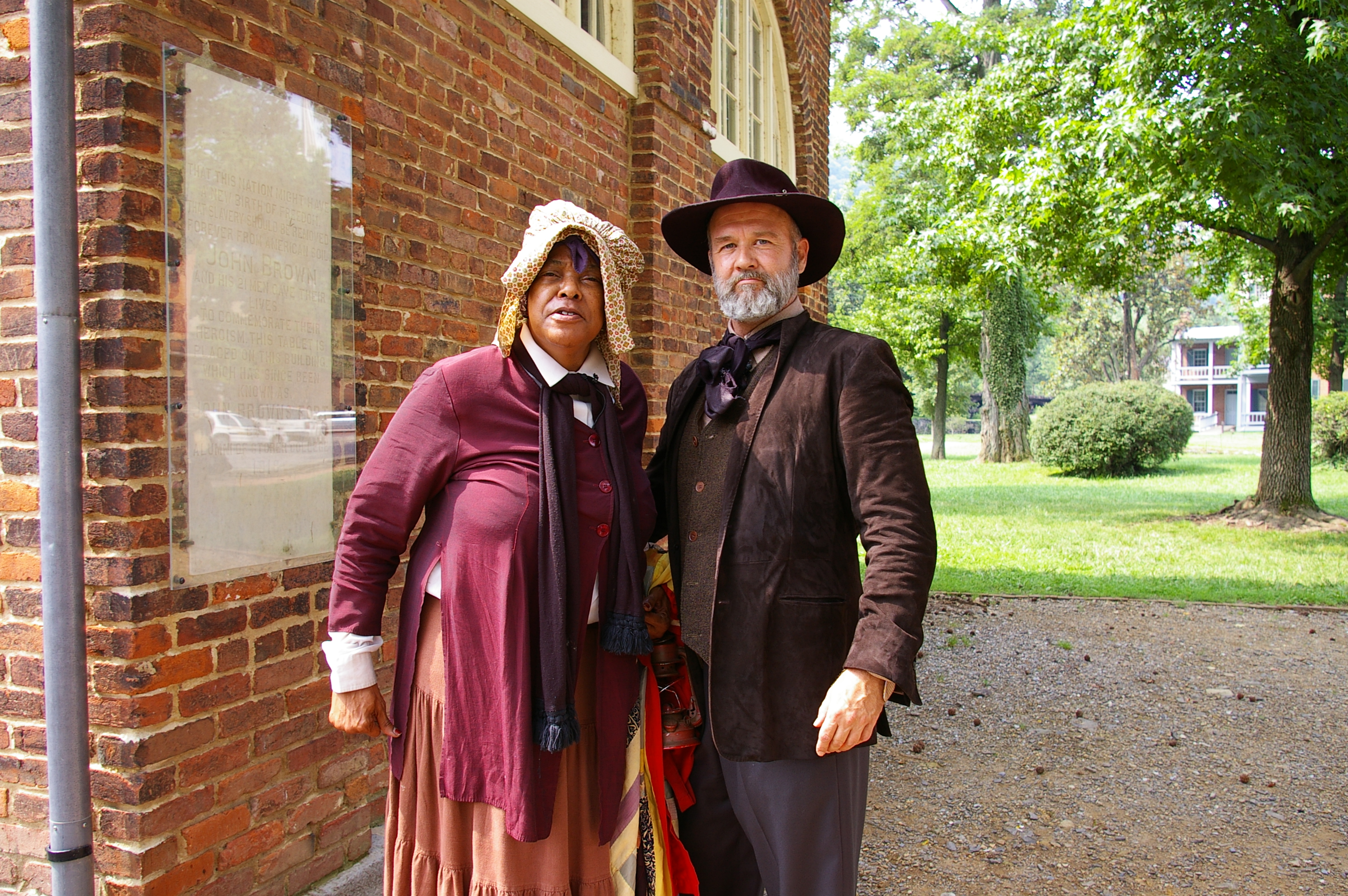
During my hiatus from the subject of Scientology – 05-08 – I spent a great deal of time studying the abolition movement of the 19th Century.   That included a lot of reading of the works and about the lives of the leading lights of America’s second revolution; including Paine, Emerson, Garrison, Thoreau, Harriett Tubman and Frederick Douglass.  I worked during ’06 with an educational entertainment teacher I met at the Buffalo Soldiers Museum in Houston.  She recruited me to play Old John Brown to her Harriett Tubman.  We were invited to perform at the 2006 NAACP convention in Washington D.C.  We traveled with all NAACP delegates by chartered train to Harper’s Ferry for the NAACP’s special commemoration to Brown and W.E.B. Dubois.  Here is “Harriett” and me at the reconstructed old fire house at Harper’s Ferry where Brown made his last stand:
140706 037

During this period, probably the most influential work that directed my attention back to Scientology and contemplating the effects it had had on me and others was Narrative of the Life of Frederick Douglass, An American Slave.  Particularly compelling to me was Douglass’ description of his childhood realization of the first – and most viciously enforced – mechanic of slavery.  That rule was that slaves were prohibited to learn.  It is understandable.  The slave holders correctly reckoned that if a slave learned to read it might lead to independent thinking.  It might also lead to reading books and learning about the world outside the plantation.  And of course that could lead to notions about expanding one’s horizons and leaving slavery in order to do so.

This 05-08 period really informs everything I have attempted to accomplish since.   Abolition of slavery.

My first public utterance about Scientology was posted in February, 2009.  It has been continuously posted since, as the Welcome Page on this blog.  Since that time it encompasses everything I have said and done in relation to David Miscavige, Scientology Inc., the subject of Scientology and Scientologists.

This ride has entailed operating an underground railroad to assist with the physical escape from slavery.  Remember the chronicles of John (JB) Brousseau and Daniel Montalvo.  When those bright or desperate enough to make that move called, we were there for them (and still are should the need arise again).

Having counseled somewhere upward of 150 people directly, and hundreds more through correspondence, and having continued our own education and evolution through the journey, I find we are still holding true to the original representation on the Welcome Page.   However, having evolved and having studied the origins and mechanisms of Scientology and its particular effects on Scientologists from all walks of life, we have learned about its sophisticated mechanisms that create mental slavery.

It was puzzling to us that David Miscavige would continue to be obsessed with us after we did everything in our power to move away from confrontation, give him the benefit of the doubt in published essays and books, and simply assist individually with those former slaves who needed a hand straightening up their spines and freeing their minds.

It was only a review of this broader history and its context that answered the conundrum for me.   It serves to confirm for me that in fact we are accurately discovering and communicating the slave master’s ‘tech’ for manning his dwindling plantations.  His response is the same as the nineteenth-century slave holders’s response to the abolitionists.  That is, attempt to re-enslave them or to ruin them utterly of course if possible, short of re-enslavement.

This review also informs my future.   My work is only just beginning.

Scientology’s slavery will be abolished.

The Bridge Beyond The Bridge

By Don Jolly in The Revealer: A Review of Religion and Media:

Mark Rathbun’s Search For the Future of Scientology

Comal County, Texas

From some recent visitors:

Thank you both so much for having and sharing your beautiful space with me.  The environment here is really perfect for working on spiritual advancement.

This visit has been exactly what I need to sort out ‘confusions’ that lingered – some I didn’t even know were there.

I am looking forward to living with my new awareness.  Thank you.

IMG_1646

Guadalupe River

Marty and Mosey,

Today is 5 of 7 and I woke up this morning asking myself ‘if this is what auditing was meant to be by Hubbard,  then what-da-f___  was I doing while in the church?  I do not recall having the kind of experience I’m having here at Casablanca.  I came here with the intention of wanting peace and quiet – and time to reflect on all that has happened in my life.  Since I left the cult I have been trying to sort out all the confusion in my head, and it is being sorted out in the sessions you have been doing on me, Marty.

There is something serene about having deer roam about your property and as I watch them from my bedroom window the song ‘long time sun’ by Snatam Kaur comes to mind.  You can find it on Youtube, it’s four minutes long.

Namaste,

DSCN0708

Sweet Pea

Came here with ‘stuff.’

Now – so quiet, so at peace.

This has been a most amazing experience.

I leave with clean water at all levels.  The mud has settled.

Mark, Monique and all the animal friends became part of my life.  I will forever feel this is a second home, a safe refuge, a place of memories and experiences.

The ‘life coaching’ – more than just auditing – was spot on and very validating of native beingness.

Thanks to all.

Loving kindness,

A visiting soul on the awareness journey we call life

DSCN0615

Pedernales River

Crossing Over

There comes a time when it well behooves one to review the bidding in the game called life.

What follows are some thoughts that some might find useful in such a review.

I have used the term ‘construct’ many times on this blog and in my books.   This is the definition I have mainly been using:

Noun

1 b :  a working hypothesis or concept <the unconscious was a construct that came from the daily effort to understand patients>

To date I have used the term mainly in reference to the space opera scenarios inculcated into Scientologists at the upper levels of the Scientology.

I believe that one reason some Scientologists have so hysterically reacted to the idea of considering such indoctrinations as constructs is that they are implanted to believe constructs to be unalterable truths from the get-go of their Scientology experiences.   Consequently, they are living in a sort of parallel universe; an agreed upon and reinforced one that requires such firm policies and notions as ‘disconnection’, ‘squirreling’, ‘treason and enemy conditions’ and the like to protect its constructs from analysis against data of comparable magnitude .  By adopting such self-constricting, voluntary-ignorance vows,  Scientologist can be thoroughly dissociated from observation outside of their firmly believed constructs.

With that introduction, I am going float an idea that is liable to shock the sensibilities of the most liberal minded Scientologist.  That is that just about everything one learns in Dianetics and Scientology is a  construct; a working hypotheses or concept to hold in order to practice a ritual.

In fact, the very first unalterable law one learns is so thoroughly implanted as unquestionable fact that what I am about to impart is pretty much guaranteed to lose me friends and readers.   But, I’ll go ahead and share the idea, confident that it will be of some service to some who have made honest efforts to integrate, evolve and transcend their Scientology experiences.

All of Dianetics and Scientology from one’s first introduction through the highest of OT Levels are utterly dependent upon this first construct.   I will be the first to vouch for its workability to a certain level.  I will also be the first to state that if not evolved and transcended from, continued adherence and reverence to it is the very glue holding a debilitating addiction in firm control of the individual.

That construct is the equation expressed as a fundamental law of the universe even three years before the publication of Dianetics: The Modern Science of Mental Health.  The equation is “the individual is lesser than bank (the reactive or subconscious mind).  Auditor plus individual are greater than bank .”

If one were allowed freedom to experience the ‘state’ of Clear (the long-held goal of Dianetics and Scientology) one could not help but to soon realize that upon attaining Clear.   But, that is not allowed in Scientology.  Instead, the equation is re-stated with a great deal of false promise and threat of eternal damnation upon the attainment of Clear.

Some people who have moved on through solo auditing will understandably chafe “that’s bullshit, when I solo audit it is me against the ‘bank’.”  And here is where the thought stopping theater of the absurd begins.  First, what bank?  It was supposed to have vanished at attainment of Clear.  The reaction from the die-hard Scientologist of course is that he feels betrayed by this question because it is the ‘bank’ he has vowed never to converse about.  So, the conversation ends there with some.   And the solo-auditor will assiduously go on confronting the bank that no one can speak about, directed every step of the way by his solo C/S (case supervisor), solo D of P (director of processing), Master at Arms (Ethics Officer), ad infinitum.  In other words, it is no longer ‘auditor plus individual is greater than bank’, it is more like ‘individual plus C/S, plus D of P, plus MAA, plus the Sea Organization, and the 5th Sector cavalry might have a fighting chance against the inter-galactic forces of evil that constitute what is wrong him.’

Few, it seems, stop to contemplate and recognize that the further one goes, the more formidable, and interminable his baggage becomes in Scientology.   Fewer still, it seems, recognize the construct nature of the fundamental law that served as the glue to addict him or her to cult life in the first place.

‘The bank is great than individual’ or ‘the individual is lesser than the bank’ is an invented construct.  It has its uses.  But, it is not a fact.

Those who have achieved Clear in Scientology might learn a handy lesson from the man L. Ron Hubbard once claimed to be the architect of the heritage of Scientology, and once claimed to be himself, Siddhartha Gautauma.    The Buddha has been reported as passing along this little parable:

A man walking along a highroad sees a great river, its near bank dangerous and frightening, its far bank safe.  He collects sticks and foliage, makes a raft, paddles across the river, and reaches the other shore . Now suppose that, after he reaches the other shore, he takes the raft and puts it on his head and walks with it on his head wherever he goes.  Would he be using the raft in an appropriate way?  No;  a reasonable man will realize that the raft has been very useful to him in crossing the river and arriving safely on the other shore, but that once he has arrived, it is proper to leave the raft behind and walk without it . This is using the raft appropriately.

In the same way, all truths should be used to cross over; they should not be held on to once you have arrived.  You should let go of even the most profound insight or the most wholesome teaching; all the more so, unwholeseome teachings.


Monique Rathbun

News about Monique

My comment:

Ability

Related posts:

What We Do: Part 1

Graduating Scientology (What We Do: Part Two)

What We Do: Part Three

Ability

In my estimation one of L. Ron Hubbard’s most important contributions to spiritual psychotherapy was his guided approach to witnessing.  The Scientology Grades were for the most part developed in Ron’s attempt to build a smoother, more sure-fire route to ‘Clear’, which he defined as the ‘unrepressed, self-determined’ state of being that is not continuing to unwittingly create his or her own mental barriers.  Engram running of the early fifties was a grinding, messy affair.  Notwithstanding ample claims otherwise in Scientology publications and lectures, the results were inconsistent and many times catastrophic.  Fifteen years of experimentation and research led to the introduction of the Grade Chart.  It was the culmination of years of research on how to achieve ‘Clear’ more rapidly and certainly than with the uncertain, hit-and-miss Dianetics engram running method.

As Ron developed each Scientology grade, along the line he claimed that each, individually, was the answer to attaining Clear, quite independent of one another.  For example, Grade 0 is the Communication grade.   The book that serves as the backbone of Grade 0 technology – and the auditing (communication) process itself – is called Dianetics 55!   The book explains the entire universe within the sole construct of communication.   It posits that if one were perfectly ‘cleared’ on the subject of communication one would have no ‘case’ (the cumulative aberration of an individual) and thus would not only be Clear, but also OT (Operating Thetan, later ‘higher’ postulated state of being).

It is the same for Grade 1 (problems), Grade 2 (hostilities and sufferings), Grade 3 (change), and Grade 4 (fixed conditions and ability to do new things).   The statement of those goals, intentions, and results at each Grade were memorialized in his lectures along the way.  And at every level you can find Ron postulating – in fact, stating as factual certainty in his own inimitable style – that that grade is the answer to Clear and beyond.

During much of that research period Ron included a caveat about each of those levels being the answer in and of itself.  That is, that if an auditor were addressing the recipient-client from the perspective and with the intention of improving ability his postulated Clear and beyond could and would occur.  Addressing ability was starkly in contrast to the approach in Dianetics, which attacked disabilities.   This is well covered in the Ability Congress lectures.  There, Ron pronounces as ‘law’ that if an auditor approaches a client with the attitude of improving ability, he will get more ability. If he focuses on addressing disability, he will cause more disability.

As was most often the case in the history of Dianetics and Scientology research, the survival considerations of fighting enemies and having the wherewithal to do so and carry on affected the ability or willingness to test out the hypotheses and claims Ron made along the way.  It was a fast-moving train constantly receiving and firing volleys, while attempting to lay ever-more instant and consistent track.  Critics of Scientology and Hubbard will give more nefarious, ill-intentioned reasons for that omission of testing.  The reason why is of little import, because regardless of causation, the fact remains.

Along the way, the once stable foundation of the priority of addressing ability as opposed to disability was lost.  I have found through 35 years of practice that this loss was fatal.  Focusing on disability results in a never-ending ‘bridge’ requiring cult-like devotion and ultimately creating regression.  Focusing on ability brings greater ability and determinism.   There is one thing that perhaps best distinguishes how we practice from others we are aware of.  Our first stable foundation is that we audit and train toward ability.

Emotions III: The Tone Scale

Someone posted here once a lecture reference where L. Ron Hubbard pronounced that ‘action’ and ‘games’, were the places to aim for in terms of chronic emotion or state of consciousness (see Real Emotions for how Scientology tends to collapse the two ideas).  The idea was that the top of the scale ‘serenity of beingness’ was far too boring for a being to stay with for very long. For those who made those ‘emotions’ their chronic targets, or their aspired to states of consciousness, here is something to think about.  Games and Action are not emotions.  They are activities.  One could and does engage in ‘games’ and ‘action’ at every level of emotion. The next higher ‘emotion’ on the Scientology emotional tone scale, Postulates, too is not an emotion – and like ‘games’ and ‘action’ is engaged in during all manner of actual emotion.  While ‘Serenity’ may well be an emotion, ‘serenity of beingness’ is probably something else entirely (more on that at another time).  Perhaps the placement of activities on the emotional tone scale contributed to some of the confusion that occurs in Scientology with respect to the role and purpose and worth of emotion.

This begs the question, are there emotions higher than exhilaration (perhaps the highest Scientology tone scale position that is fairly sure to be an emotion)?  I think it is a worthwhile exercise for people to work out for themselves how the emotional tone scale should or could or can be logically and intuitively seen to be.  That is particularly so for those who have set their life goals around the achievement of the non-emotions placed at the top of the Scientology tone scale. It can be a liberating exercise.  I have done a lot of work on it myself – by self-observation and observation of others.  I share some of my notes on it below.  This sharing is not for the purposes of indoctrinating or selling an idea.  Instead it is provided in order to stimulate thought and conversation and input.  The plain type items accompanied by numbers are from the original Hubbard Tone Scale In Full.  The italicized typed items are tones on the existing scale that I question as being emotions in the first place (as noted above).  The bold-faced, italicized entries are emotions I added by observation in their relative positions to the existing Tone Scale In Full.


Bliss, Pan-equilibrium (Non-Duality)

Serenity, equilibrium (Justice)

40.0  Serenity of  Beingness                                          Know

Compassion (Responsibility)

Care  (Nurturing)

Empathy (Transcendence of ego/pan-emotion)

Appreciation (Acknowledgment)

Release (Letting go)

30.0  Postulates                                                                Not Know

22.0  Games                                                                       Know About

20.0  Action                                                                         Look

8      Exhilaration                                                              Plus Emotion

6      Aesthetics

4      Enthusiasm

3.5  Cheerfulness

3.3  Strong Interest

3.0  Conservatism

2.9  Mild Interest

2.8  Contented

2.6  Disinterested

2.5  Boredom

2.4  Monotony

Real Emotions

Somewhere along the way emotion was converted into equating with states or levels of consciousness in Scientology.  In the process emotion became a negative humanoid attribute, e.g. writing off any feeling or expression of emotion off as ‘human emotion and reaction’ or ‘h, e and r.’

Emotion and grades of awareness or consciousness are not the same thing.

Wikipedia gives a good definition for emotion that was no doubt contributed to by a number of interested people from a variety of religious, philosophical, scientific and educational backgrounds.  It is as follows:

In psychology and philosophy, emotion is a subjective, conscious experience that is characterized primarily by psychophysiological expressions, biological reactions, and mental states. Emotion is often associated and considered reciprocally influential with mood, temperament, personality, disposition, and motivation,as well as influenced by hormones and neurotransmitters such as dopamine, noradrenaline, serotonin, oxytocin, cortisol and GABA. Emotion is often the driving force behind motivation, positive or negative.

That definition is not inconsistent with Scientology definitions, even if it is far more comprehensive.

The last sentence bears some thought, ‘Emotion is often the driving force behind motivation, positive or negative.’    Carl Rogers has noted that emotion can serve as an important referent to deriving meaning.  For example, an issue that confronts you causes sadness.   In processing that emotion, it might inform your conscience and influence you to decide to do something worthy about the situation.  That in turn could result in your feeling some more pleasurable emotions.

If instead you used a mental trick to lift you out of sadness, you may well simply feel comfortable – in the short run – in forgetting that which made you sad.  Your conscience is bypassed in the equation; and the situation that perhaps legitimately engendered feelings of sadness remains unaddressed.   Would that be ethical?  Would that be pro-survival?  You’d have to think of examples of real situations and work it out for yourself.

Imagine habitually utilizing exercises that rose you from genuine emotions caused by real situations that confronted you.   What would ultimately happen to your conscience?   How real and worthy and meaningful a life would you wind up living?

Perhaps because emotion is mistaken for a level, grade, or state of consciousness in Scientology the culture tends to frown on having, demonstrating or processing emotions per se.  They certainly are not recognized as anything worthy of serving as a referent to deriving meaningful meaning.  Emotion instead becomes something to get out of, something to rise above, or something to manipulate in others.  Techniques abound in Scientology for achieving that.  Nothing wrong with such tools provided they are used wisely.  When I say wisely, I mean not done so habitually and consistently that one becomes emotionless.  In Scientology cultures, folks can become downright anti-emotional to the point where conscience is effectively forfeited.  That would seem to be a factor in Scientologists’ facile ability to turn their backs on loved ones, associates, family, and  friends; and even to proudly avow to never fear to hurt another in a just cause.

If you’ve been in Scientology culture for very long, I invite you to have and process for yourself some real emotion.  Don’t try to repress it, suppress it, avoid it, evade it, escape it, conquer it or ‘causatively’ rise above it.  Instead, feel it for all it is worth.  See for yourself whether sometimes emotion can inform your conscience and your decisions and lead to more rewarding and meaningful activity on your part.

What We Do, Part One

For some orientation to what I would like to over in this essay I begin with a passage from Chapter 25 Epilogue from Memoirs of a Scientology Warrior (Amazon Books, 2013):

     As has been ably reported by Janet Reitman in her book Inside Scientology (Houghton Mifflin, 2011) and by Lawrence Wright in his book Going Clear (Alfred A. Knopf, 2013), L. Ron Hubbard was a very capable marketing man. What they did not acknowledge as much, but did not totally discount, was Ron’s ability to solve problems – including those of the mind and spirit. Ron had a knack for finding out what was bothering people, putting together methods to address those things, and then selling those methods as services – the end-all that people just had to get their hands on.

     The Reitman and Wright books detailed how Ron was continually creating new rundowns, new levels and new packaging to keep the Scientology public enthused over the latest in the mind and spirit.  It was the formula that created continuing expansion of the Scientology empire during L. Ron Hubbard’s life.  A strong customer base was established and continually kept interested and buying as new, essential route-to-total-freedom items were rolled out.

     Because Ron so unequivocally mandated that only Ron could discover, create and memorialize mental and spiritual technology (the only stock-in-trade of the church of Scientology) upon Ron’s death the church’s expansion pattern also died.

     Consequently, David Miscavige took on an unenviable task when he was handed the reins of Scientology Inc.  And those reins were handed to him, whether begrudgingly or not, by Annie Tidman Broeker (Loyal Officer 2) when she sided with Miscavige against her then-husband (Loyal Officer 1) Pat Broeker. Miscavige had no choice but to radically change Scientology’s forty-year expansion pattern.

     The movement had been built and held together primarily through the promise and continual roll-out of new technology. Now Miscavige had to keep that movement going, but with no possibility of introducing new technology. For a while he seemed to have somewhat of a grasp of marketing, but all the marketing in the world could not keep an organization thriving when it had nothing new to sell. At least not an organization whose viability depended on continual emanation of new technology to sell. And by firm religious belief and church doctrine, he was powerless to create any new technology.

These facts – recognized by credible, outside observers and by insiders like myself – are at the heart of why Scientology (the whole package) is as dead as a door nail.  The promises are infinite while the delivery of them is impossible.

The first thing that probably distinguishes us from all others we are aware of who utilize some of the discoveries of Ron Hubbard is that we do not play – in any way, shape, fashion, or form – the baiting evaluation game that comes part and parcel with Scientology.  That is the incessant, overt and covert, game of continuous evaluations along the line of ‘the next roll out will really get you there’, ‘the next level will handle your problem’, ‘you need to act in this fashion so that you see the wisdom of taking your next step’, ‘you’ll understand that when you get to ______’, or any other of the pitches that were memorialized in unalterable, firm Scientology policy and mental technology throughout the years.

That most decidedly includes the insidious safety valve, bait-and-switch line ‘the reason it didn’t work for you was that it was corrupted by someone else, and now we’re going to give you the real thing’ as is so regularly chanted by the church and the shadow it casts, Scientology practitioners outside of the church.  The real thing is precisely what is described in the book passage above: the never-ending promises to the stairway to Heaven that demonstrably does not lead to Heaven.  It more often leads instead to the perfect cognitive storm: holding these two conflicting ideas counterpoised,  a) I have done everything Ron prescribed, so I know everything there is to know, and can never improve because I am already perfect – b) all the while colliding with the deep-down, suppressed self-recognition that the individual has become intolerant, arrogant, callous and miserable.

This find-the-ruin, bait-and-switch mentality is woven into the woof and warp of Scientology.  It gets played from initial marketing to the highest reaches of the bridge. It has always been, both inside the church and without, that those who play it best are sainted with being the most ‘On Source’ (with L. Ron Hubbard) Scientologists.

It also happens to be Ron’s first,  greatest  – and ultimately most fatal – departure from the technology he primarily borrowed from in creating Dianetics and Scientology: Rogerian client-centered psychotherapy.  The second the client is played – in any way, shape, fashion or form – by definition the process is no longer client centered.  Instead, it by definition becomes practitioner – or organization – centered. The road to restoration of self-determinism becomes paved with enforcement of obedient following.

Do I mean to say that Ron was a con?   Do I mean to say that everything he discovered or purported to discover was fraudulent?   No; as you shall see in further installments.  But, I am defining what it is we do and the first thing we do is stay true to the client-centered philosophy that is at the heart of – in fact, is the sine qua non of – all that is workable in Scientology.

Ishmael


Some folks have found my repeated reference to the Tao Te Ching to be puzzling.  Some Scientologists have simply used it to write me off as being lost. The Tao is such a radical departure from the ‘philosophy’ Scientologists learn and abide by – even while denying to themselves such adherence exists – that some dismiss it as philosophical gobbledygook.  I have commented on the polar nature of those philosophies (Scientology and the Tao) and noted it as an important reason to become acquainted with the Tao, e.g. The Tao of Scientology.

The fact of the matter is that a consistent construct in Scientology requires the adherent to mock up and act out the identity of conquerer.  For example, a Scientologist is taught to view the universe as an epic struggle of the spirit’s sole mission as the conquest of the physical universe.  Such a view can and often does, if not mitigated by deeper understandings, result in destruction of that which one programs oneself to conquest; not to mention the weakening or destruction of the ‘conquerer’ himself.

Many have recognized this on some level and have departed the church because of the dangerous environment such a philosophy ultimately creates.  Many of them spend years then applying an harmonic of this same warlike philosophy toward the church, ‘it is the church or current management that needs to be conquered.’  Others facilely write off the ‘conquest’ attitude as an attribute of church management and go off to apply what they call ‘real Scientology’ independently.   Inevitably, to the degree they avow to remain loyal to Scientology ‘philosophy’, those independents wind up playing the conquest game against one another.  It happened with the first independent movement in the eighties and the second one more recently.

To the extent one recognizes this mentality in himself he objectivizes it and can thus let it go.  An increase in equanimity and personal peace can ensue.  That which was useful and survival for someone in his or her Scientology experience can more easily and naturally be recognized and reinforced.  That which was of negative worth and non-survival can be recognized and let go of.

The continuing recommendation of the Tao as integral reading and understanding was meant to set this salutary evolution in progress.

But, I understand how ‘left field’ this recommendation can seem to those living the Scientology construct of ‘conquest of matter, energy, space and time’, ‘conquering the reactive mind’, ‘putting ethics in on the planet’, ‘gaining territory for Scientology’, etc.

I just read a book that may help to bridge the gap between the necessity-of-conquest think and learning to let go or living and letting live.  It communicates the essence of the Tao (without ever making any reference to it) in more modern terms.  It does so in an entertaining and currently-relevant fashion.   That book is Ishmael: An Adventure of the Mind and Spirit by Daniel Quinn.  It is a novel that tells a story in a creative, unique and interesting setting  – a story that is captivating in and of itself.  It explores some scientific, philosophic and religious constructs that Scientologists are taught early-on to discard in their entirety – the Bible and Evolution of Species.  In that regard, those who have bought into and scrupulously adhered to Hubbard’s wholesale rejection of such fields will learn a little something about perhaps the two most common poles of thought on this planet.  You don’t have to buy into either of those poles, but I bet you will never look at them (or those who believe in them) the same way.  You might recognize the parallels of both with Scientology philosophy and thus be more able to put Scientology and your experience with it in a sane and nurturing context. Maybe more importantly, you might begin to take a more realistic, informed view of the planet, humanity, and civilization and your participation in it.