Category Archives: the future

The Future

I am in the process of writing two books related to Scientology.  It seems to me at this juncture of that process that they will probably be the last I write about Scientology.  In keeping with the philosophy I follow in helping people on a one-to-one basis, I am writing with the purpose of assisting people in a fashion that does me out of a job.  I think that modus operandi evolved out of recognition that somewhere along the road Scientology sowed its own seeds of destruction by inculcating a sort of unhealthy dependency.  I consider what I do to be of the nature of outfitting and guiding folk to begin charting their own paths.  Hopefully the books will relate all that I know to be workable in assisting people to move on up a little higher.  The first book is about moving up from the ultimate trap that is Scientology for those stuck in it to one degree or another. The second book is about applying Hubbard’s workable discoveries in an integrated fashion that proofs one up against getting entrapped in the first place while seeking higher levels of awareness and consciousness.

The former is a recommended guide for moving on up beyond what Scientology has to offer. The latter is a recommended guide for integrating safe and sane application of that in Scientology that can be effective for those who wish to apply it.   That is, an integral practice which by my own estimation is the only fashion by which Hubbard’s workable ideas will survive or serve salutary purposes for future generations.

All of my books to date, including the first future one introduced here, are directed at a very limited audience: Scientologists and potential users of Hubbard methods.  As much as Scientologists and even former Scientologists would like to convince themselves otherwise, I know this to be a tiny minority in today’s society.  The audience is so limited that writing books on the subject is not a means to make a living; in fact it is an impediment to doing so.  The books are written out of a sense of obligation for imparting what I have learned through my own experiences of moving into, through, and beyond Scientology.  It is my hope that somewhere down the line that the audience for the second book, the integral guide, might gain a wider audience;  or, at least, serve to get some of Hubbard’s ideas into the conversation and mix in future integral mental and spiritual practices.

By necessity, the books are second in priority at the moment to making a living.  When they might be completed will be determined by the time I can find for completing them.  Notions of integrating, evolving and transcending are apparently not the most popular among former members; and most certainly, thinkers and researchers in integral practice don’t want to even hear the words ‘L. Ron Hubbard’, ‘Scientology’, or ‘Dianetics’. Resources and interest in the former church member community seem to be increasingly directed toward efforts to expose Scientology as a scam, expose and denigrate church leadership as the why for Scientology’s unworkable or destructive aspects, or even – of late – attempting to resurrect a weak imitation of the original.

In the interim so that nobody feels like a mystery is being dangled, virtually everything I have to publish can easily be derived from everything I have already written (in three books and nearly 1,100 blog posts; including its recommended reading).   I don’t purport to have brilliant, original new ideas.  I think all of them that are useful to moving to greater heights have already been better articulated by others.   My ideas simply have to do with connecting dots that have long since been created by others.  I have decided to write the books to organize those thoughts for the benefit of a) those ingrained by Scientology with the need for structure, construct and maps,  b) the loud few, and those they confuse, who insist it is dangerous to read my words because ‘I don’t know where Marty is going’, and c) (and perhaps most importantly in the long term) future integral practitioners who could benefit others by incorporating workable ideas of L. Ron Hubbard into programs of human betterment.

The two future books I have mentioned will largely focus on integration, evolution and transcendence.  The previous three books and the blog have focused more on identification, association and differentiation so as to possibly awaken folk to the necessity or wisdom of integrating, evolving, and transcending.   I will continue to attempt to do that on the blog as time permits.
Why Bother?

Some hard-core ‘independent’ Scientologists have ruminated  among themselves lately the idea that I am somehow trying to bring down L. Ron Hubbard and Scientology.  Otherwise, they reason,  ‘why wouldn’t he just move on and let it be?’   I am going to try to address this concern as directly and succinctly as I can.

L. Ron Hubbard developed a number of unique, aggressive methods for tackling problems of the human psyche.   Used intelligently there is nothing that compares to their direct, predictable effectiveness in intensifying present awareness.

However, there is a potential trap in the fields of therapy and spiritual practices discussed by Ken Wilber in his Kosmic Consciousness interview series that applies in spades to Scientology.  In segment eight of the series, Wilber speaks of people attaining ecstatic, exalted altered states in their particular discipline that they consider to be so miraculous as to be without compare.  They are convinced that they have found the only way, which results in a sort of tunnel vision and puts a figurative ceiling on their own continued growth and development.  Such people become opinionated, exclusive and intolerant – ultimately repelling others from experiencing the transcendence they experienced and losing whatever they gained in the process.

This trap is particularly acute in Scientology, because along with the peak and plateau experiences it delivers, its scripture is saturated with reinforcement of this sense of only-one way and superiority to mere mortals.  As intensively and effectively as Scientology can focus an individual’s attention and concentration, it just as intensively and effectively conditions those new found abilities onto worshipping and defending to the death the construct that made them possible.

In an ironic way, the zealous, judgmental, super egoic, ‘I will save you if I have to kill you’ mentality of the advanced Scientologist serves as testament to the effectiveness of that which they are hell-bent on defending and promoting.

Just as assuredly, it is evidence that somewhere along the line the science of ‘knowing how to know’ is converted into the practice of ‘knowing so best that we had better not be exposed to learning anything else and not allow anyone else to either’.

The observation I am trying to share is that it is this vicious cycle that is at the root of the demise of the methodologies of Dianetics and Scientology.  It is the cause of every other ill – disconnection, fair game, Simon Bolivar, violence in management, money is everything,  image is everything, you name it – every other ‘situation’ that folk continually mistake for the ‘why.’

I have witnessed tremendous relief, rehabilitated ability to learn, and renewed capacity for transcendence by getting this ‘why’ understood by many who have devoted their lives to Scientology.   I have also effectively helped a number of people with Hubbard methods by using them – sans the only-one religious indoctrination;  people who knew little to nothing of Dianetics and Scientology when they came to me.

It is for this reason that I believe the ideas of L. Ron Hubbard are doomed to the extent they are not used in an integral (integrated) fashion.   The whole package – taken as the whole package requires it be taken – leads inevitably to all of the ills ex-scientologists, those effected by Scientologists, and Scientologists (including and especially independent ones) seem to make a pastime out of clamoring about.

Why do I bother?  Because I want to help free those who are stuck in this Scientology dichotomy, and because I don’t want to see the demise of ideas and discoveries that can be effective in helping people in the future.

What’s Going On?

I came across an interesting passage in a book – the passage originally published in 1963 – by a prominent psychologist predicting quantum advancements in human consciousness by the marrying of religious and philosophic wisdom with rapidly evolving science. It is fifty years later and it seems Scientology is only now beginning to go through the throes of differentiating the adults (truth seeking spiritualists and values inspired scientists) from the children (flat earth religionists and reductionist-mechanistic inclined scientists).  Scientology seems, to steal a verse from U2, stuck in a moment that it can’t get out of.  From Religions, Values, and Peak-Experiences, by Abraham H. Maslow:

These two groups (sophisticated theologians and sophisticated scientists) seem to be coming closer and closer together in their conception of the universe as ‘organismic’, as having some kind of unity and integration, as growing and evolving and having direction and, therefore, having some kind of ‘meaning.’ Whether or not to call this integration ‘God’ finally gets to be an arbitrary decision and a personal indulgence determined by one’s personal myths.  John Dewey, an agnostic, decided for strategic and communicative purposes to retain the word ‘God’, defining it in a naturalistic way.  Others have decided against using it also for strategic reasons.  What we wind up with is a new situation in the history of the problem in which a ‘serious’ Buddhist let us say, one who is concerned with ‘ultimate concerns’ and with Tillich’s ‘dimensions of depth’, is more co-religionist to a ‘serious’ agnostic than he is to a conventional, superficial, other-directed Buddhist for whom religion is only habit or custom, i.e., behavior.

Indeed, these ‘serious’ people are coming so close together as to suggest that they are becoming a single party of mankind, the earnest ones, the seeking, the questioning, probing ones, the ones who are not sure, the ones with a ‘tragic sense of life’, the explorers of the depths and of the heights, the ‘saving remnant.’  The other party then is made up of all the superficial, the moment-bound, the herebound ones, those who are totally absorbed with the trivial, those who are ‘plated with piety, not alloyed with it’, those who are reduced to the concrete, to the momentary, and to the immediately selfish.  Almost, we could say, we wind up with adults, on the one hand, and children, on the other. 

The Great Decompression

I borrowed, or coined by inspiration, from Viktor Frankl (Man’s Search For Meaning) the idea that decompression was the first and most important step in recovering from the Scientology experience with an upward trajectory.  Frankl – having himself survived years of imprisonment in Nazi concentration camps, and attempted to help others similarly situated upon release – noted that an adjustment period was critical for someone coming out of a strictly controlled environment to a relatively free society.  He likened it to a deep sea diver submerged for several hours far beneath the surface.  One must bring the diver back out from under the tremendous pressure he has adjusted to on a gradient basis or he will suffer from Decompression Sickness, also known as the bends. Similarly, if a person imprisoned – even mentally – in inhumane conditions, conditioned to think and act in super-compliant ways while developing all manner of deceitful (albeit as justifiable as they may be) means to survive, comes out acting like he owns earth he is going to be in for big, ugly and possibly devastating losses.

Over time I have exchanged observations with other counselors about a number of folks that we guided and assisted through the Scientology Underground Railroad – or Decompression Road.  One pattern we all have observed, and taken terrible losses on, is Scientologists entering the family of humanity with the exclusive, arrogant and judgmental attitudes they developed to survive in Scientology culture.  All of us have expended a great deal of resource and effort in helping to clean up messes such attitudes have created, and in getting people who exhibit those attitudes back on their paths after the inevitable smack downs society tends to deliver in response.   For those going through that process now, and who are discomforted absent orientation to L. Ron Hubbard references, everything I have noted thus far in this article is in complete accord with Scientology notions of the efficacy of tackling problems,development and life on a gradient scale; and even the ethics conditions formulas (see Non- Existence condition and formula).

One of the first posts on the Milestone 2/iscientology blog – created largely in protest of my books and this forum – was a piece attempting to discredit this idea of decompression as some psych-based attempt to belittle Operating Thetans and put people at introverted effect.  It reasoned that former Sea Org members and public OTs who bought into the idea they could use a tad of decompression as part of their gradient entry into the community of fellow human beings were victims of an attempt to put them at groveling effect of the psych-indoctrinated ‘wog’ world.  By God, the MS2ers proclaimed, we need to bring society up to our standards, Revenimus! (In keeping perhaps with the Class VIII indoctrination, ‘you are the people who own the planet’ – see Memoirs of a Scientology Warrior).  This mentality of wanting to cling to the inside is understandable (see e.g. the films  The Shawshank Redemption and One Flew Over The Cuckoo’s Nest – I know you have all seen them, but watch them again with the Scientology experience in mind).

These thoughts arose when considering a general response to the many inquiries I have received lately asking me which of my three books ought to be read in what sequence.   That includes a lot of non-Scientologists asking what book might appeal to or help a Scientologist family member or friend. My answer is always a question, eliciting information on where the person is at on the decompression process.  When I know something about their circumstances I can recommend the single book that I think might help the person concerned.  They do not necessarily flow one to the next in the order they were written.  And all three of them aren’t for everybody necessarily.

So here is a short generalized guide to whom I believe the three books individually might appeal to, and hopefully help  –  in alignment to degrees of decompression already experienced by the concerned person.

The Scientology Reformation.

This book was written primarily with Scientologists still connected with the church in mind.  It is anchored upon L. Ron Hubbard references and attempts, on a gradient basis, to get a Scientologist to observe for himself or herself just how far adrift Scientology Inc has strayed from the intent and purposes memorialized (at least in some places) by its founder.  It introduces hope that one need not reject all of Scientology, in order to escape and even to take a stand against its abuses.

What Is Wrong With Scientology? Healing Through Understanding

This book would likely be dropped like a radioactive rock by the time a Scientologist in good standing read the first sentence of the introduction.   It is addressed more to people who are already out of the church, and for whom turning back is no option.  It is a detailed presentation and analysis of the features of Scientology that tend toward entrapment.   It describes in some detail the sum and substance of what Scientology’s effective processes are  in order to set the table for analyzing what is wrong with it and how it is ultimately used to entrap.   If one only mindlessly makes a break and declares a wholesale rejection of everything scientology, one tends to become as glued to it as ever, albeit from the opposition vector.  That is because he or she never took the time to understand and come to grips with what salutary aspects of it may have kept one pursuing it in the first place.  If one understands that, one can transcend the experience in a more desirable state than victimhood.

Memoirs of a Scientology Warrior

Because of the personal, autobiographical nature of this book and its consequent gradual, real time and subjective introduction to Scientology this can inform someone never involved in the subject with a perspective they will get nowhere else.  That is, what attracts and keeps one involved in the subject.   Popular books and films have been woefully two-dimensional and inaccurate in that regard.  They only focus on fear factors, which for those involved had next to zero effect in garnering their voluntary, self-determined involvement (the involvement that creates the most lasting effect on someone).  Many who have read it remarked that reading another’s real time experience of getting into, developing into a crusader for, and then transcending out of it prompted them to review their own experience more honestly, fully and rationally.  And that had a liberating effect upon them.

Memoirs is probably akin to a post-doctorate extension of the ‘what is wrong with Scientology’ analysis.  But not with a lot of opinion.  For the most part I let the facts do the talking.

While I still regularly use the term, and the model, of ‘decompression’ I am more often using it with a modifier to better describe what it is I am trying to accomplish: Decompression with an upward trajectory.

Link to all three books:

Mark Rathbun books on scientology


An Open Letter to Eddie King

I tried to walk in your shoes on Saturday.

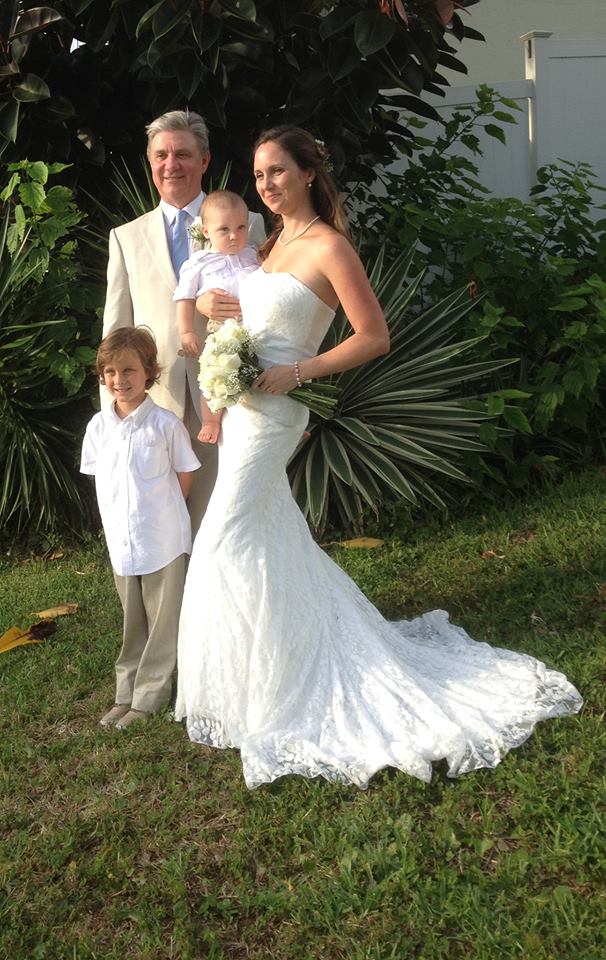
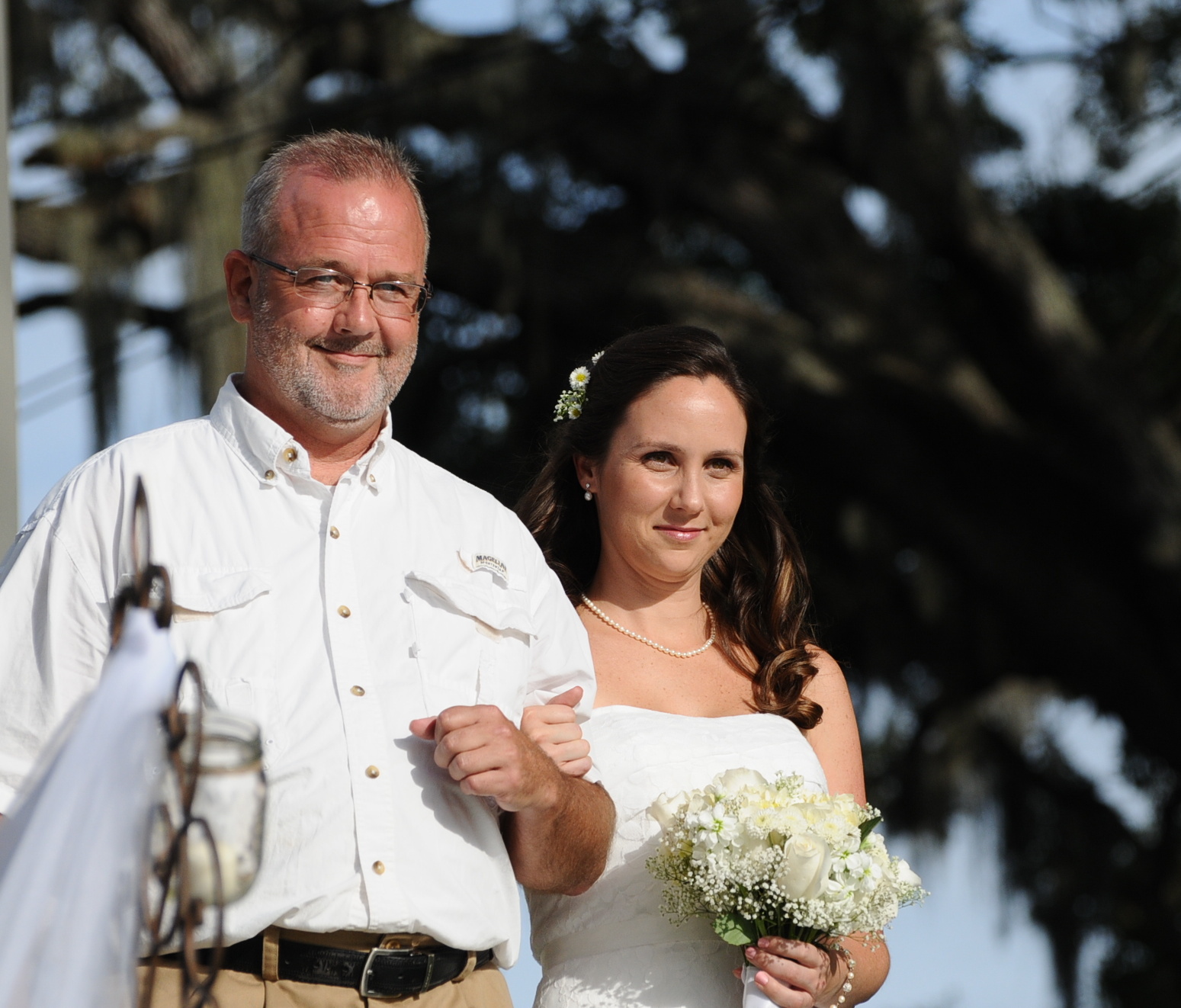
The honor of acting as the father of Christie at her wedding was bestowed upon me.

Christie may have chosen me for this privilege because I remind her so much of you.  She has told me as much on many occasions over the past four years that I have known her.  Just about every time I flip a song, she says with her inimitable smile, ‘my dad and I used to listen to that.’   From Bob Marley to Van Morrison, it seems you and I ride to a similar rhythm.

christie.me

Several times Christie has come to me for life counsel that one would normally reach out to a father for.  And when it is done she often reminisces with a glimmer in her eye that that is exactly how you would have handled it.  Ironically, when such nostalgic moments turn into tears it seems I even console her in a similar way that you used to.

I want to thank you for giving me fulfilling learning and growing opportunities. My only potential child was aborted in compliance with the firm policy of the priesthood of your church that I served most of my adult life in.  But because of your chosen absence I have been graced with the chance to come in touch with a bit of perhaps humankind’s greatest developmental growth experience: parenting.    I have not had to shed the blood, sweat and tears you have in bringing children through birth, childhood, adolescence and into adulthood.   Instead, I have been given the opportunity to temporarily substitute for you for one graduate of yours of that evolution.

rinders

I gave Christie away on Saturday with no doubts or reservations whatsoever.   As noted, apparently I have walked through life with a similar perspective to yours.   Based on the accumulation of whatever wisdom I’ve  been able to retain during that journey, I can assure you there is no finer man to be found than her husband Michael John Rinder.   He is a man of conscience molded in a crucible of adversity that few are adventurous enough to ever experience.  Few have lived a life of such selfless devotion and weathered as many vicissitudes as Mike.  And of those few, I am unaware of any who came out the back end with so much love, hope and tolerance as Mike.  You could not find a better father for your grandchildren.

jackandshane

Your grandchildren are the living proof of what I am trying to convey to you.  At fourteen months of age, Jack is a veritable lighthouse.   I think anyone who has been in his presence will agree.  He lights up every space he enters.  Shane, all of six years old, is as intelligent, mature, and at the same time insouciant, as any child I have known.

And at the center of this family, the sun that nourishes it with life-giving light, of course, is the Queen of the Slipstream – your daughter Christie King Rinder.

Thank you for letting me know and be part of this incredible family.

I want you to know that I still abide by our shared team sports ethos.  I recognize and accept that I am merely a lowly substitute.  I am doing my best to simply not let the comfortable lead you – the star – created slip away while you starters catch your breath.

There is an old proverb that says, your home is where your heart is.  When you find it in your heart to come home I will gladly step aside and be the first (of thousands) to celebrate you.

Dichotomized Religion & Sheep Production

The following is a 1964 analysis of what had happened to religions over the millennia. Interesting how it was happening in real time, first generation, to Scientology while the words were being typed.  It continues to play out in real time in the ‘independent field’ as evidenced by the commentary – and omission thereof – on this blog.  If you find yourself not to be one of the sheep described (or no longer wanting to be one), you might be interested in investigating more deeply how this applies to Scientology, by reading Memoirs of a Scientology Warrior.

From Abraham H. Maslow’s Religion, Values, and Peak Experiences :

When all that could be called ‘religious’ (naturalistically as well as supernaturalistically) was cut away from science, from knowledge, from further discovery, from the possibility of skeptical investigation, from confirming and discomfirming, and, therefore, from the possibility of purifying and improving, such a dichotomized religion was doomed.  It tended to claim that the founding revelation was complete, perfect, final, and eternal.  It had the truth, the whole truth, and had nothing more to learn, thereby being pushed into the position that has destoryed so many churches, of resisting change, of being only conservative, of being anti-intellectual and anti-scientific, of making piety and obedience exclusive of skeptical intellectuality — in effect, of contradicting naturalistic truth.

Such a split-off religion generates split-off and partial definition of all necessary concepts. For example, faith, which has perfectly respectable naturalistic meanings, as for example in Fromm’s writings, tends in the hands of an anti-intellectual church to degenerate into blind belief, sometimes even ‘belief in what you know ain’t so.’  It tends to become unquestioning obedience and last-ditch loyalty no matter what.  It tends to produce sheep rather than men.

One Good Reason To Read ‘Scientology Warrior’

Now for one reason you might want to read Memoirs of a Scientology Warrior. Tony Ortega hates the book, characterizing it as a love letter to the cult:  Ortega’s take.

Rattling both ends of the extreme is an indicia of hitting the sweet spot.  Reference:  The Great Middle Path Revisited.

Book_cover_front_back_spine21.5

Ten Reasons to Avoid ‘Scientology Warrior’

Ten reasons why you should not read Memoirs of a Scientology Warrior:

  1. If you read it, you might get the idea that Scientology is something that one ought to graduate from.  This could be particularly troubling for folk who can’t seem to get over the reunion-of-the-folks-from-the-good-old-days mentality.
  2. If you read it, you might get the idea that for Scientology to assert the idea some of its ideas are sacred and ought to remain hidden is the height of hypocrisy. This could be particularly difficult for those who cling to a sense of mystical superiority over mere mortals.
  3. If you read it, you might get the idea that Scientology is nothing more than, as Ron once noted, ‘a workable technology’.  This could be particularly trying for those who assert ‘total certainty’ on the ‘only road to total freedom.’
  4. If you read it, you might become curious as to the evolution of psychotherapeutic and spiritual practices during the time Scientology has existed.  This could be particularly upsetting to those who find comfort in knowing without doubt that anything developed or discussed outside the halls of Scientology is destructive, dangerous business.
  5. If you read it, you might get the idea that having to have someone to blame or fight is a severe limitation to one’s spiritual growth.   This could be particularly disconcerting to the ‘onward Scientology soldier’ set.
  6. If you read it, you will more than likely doubt every utterance emanating from the church of Scientology from David Miscavige on down.   This could be particularly perplexing for those who find solace in relying upon those they have decided are ‘on Source’ or ‘with Ron’ or ‘with Scientology.’
  7. If you read it, you might find out that L. Ron Hubbard did not live an immaculate resurrection as popularly accepted.   This could be particularly enturbulating to those whose gains in Scientology are based upon the  foundation of the stable datum of ‘doing what Ron would do.’
  8. If you read it, you will more than likely forever lose the ‘ends justify the means’ think that Scientology implants upon its members.   This will be particularly jarring to those weaklings who take some measure of pride in judging, denigrating, and black pr’ing those who don’t see eye to eye with them on Scientology.
  9. If you read it, you might find out that much of Scientology takes away the positive that it is also capable of producing.  This will be particularly unsettling to those who have a weak understanding on the observable mechanics that make Scientology produce results .
  10. If you read it, you might not continue to think Ron is Buddha reincarnated or, on the other hand, a grand con man.  This will be particularly troubling to those whose gains were founded upon, or bolstered by, belief. It will also cause consternation to those who have found  a safe solution in targeting Ron as inherently evil.

Now Available at Amazon Books: click here: Memoirs of a Scientology Warrior

Memoirs_Scn_Warrior_front_for_web

Scientology in Germany

Please read about and see the New Germany Independent Scientology Center (click link)- translation of text below:

On April 27 our opening party was an overwhelming success. 36 guests filled our new courseroom with a tremendous amount of theta, much more than I have ever witnessed during a comparable event. Scientologists – some had not met in 15 years – were in a real extasy of communication.

We had guests from one half of Germany. A few friends from Ron’s Org attended, too. Although we are completely separate groups we were not at all competition minded. Our center delivers auditing up to Clear and auditor training including the solo course. We use course materials produced before the alleged “golden age of tech”.

Our staff – Rita, Maria, Georg and I (Klaus) – would like to say a big thank you to all friends who had been present, whether physically or spiritually. Your huge amount of positive postulates and theta will be with our new group! We hope we will be able to go on with further renovations quickly. The rooms areavailable and as soon as they are needed we will start !

ARC

Klaus Weigel

PS.: The people on the photos have all agreed to be shown here. But there were some more guests on our party.

The Quest: Quixotian or Gandhian?

On his ‘Dean of Technology’ course titled Class VIII, L. Ron Hubbard advises that the ultimate state of consciousness attainable in Scientology (dubbed OT, for Operating Thetan) is simple.  The state is attained when the individual no longer carries any lies with him.  An individual is as OT as he doesn’t walk about with lies.

So it is with Scientology itself.  As a subject it contains a wonderful body of technology for helping to strip a person of the lies through which he filters the universe around him.  The biggest problem with broad dissemination and application of that technology is its self-imposed prohibition on differentiating that technology from the broader body of Scientology work that is chock-full of lies.

Because of the religious cloak with which L. Ron Hubbard chose to enwrap Scientology, the discernment of truth from lies within Scientology is not an easy task.  L. Ron Hubbard wrote a large body of doctrine satanizing anyone who attempts to look at his body of work in a critical fashion.  In fact, the very term ‘criticism’ – at least when directed toward Hubbard or Scientology – has been solidly re-defined in Scientology to be the activity of only sociopaths and criminals.

Thus in 1967 Hubbard published an article in a Scientology journal for all Scientologists to heed and adhere to.  Entitled Critics of Scientology it pronounced the following:

Now, get this as a technical fact, not a hopeful idea.  Every time we have investigated the background of a critic of Scientology, we have found crimes for which that person could be imprisoned under existing law. We do not find critics of Scientology who do not have criminal pasts…

…If you, the criticized, are savage enough and insistent in your demand for the crime, you’ll get the text, meter or no meter.  Never discuss Scientology with the critic.  Just discuss his or her crimes, known and unknown.  And act completely confident that those crimes exist.  Because they do.

Hubbard issued dozens of pages of directives to his church to investigate  – with the aim of destruction of – critics of Scientology.  When the ‘technical fact’ he preached above proved to be utterly false (as determined by the intelligence agency he created to prove it – called the Guardian’s Office), Hubbard advised the agency to skip the investigations, create and plant and then ‘discover’ and expose the evidence of crime.  He was particularly vicious and ruthless in his directives to destroy those who attempted to clarify, refine, or simplify Scientology technology so as to reach more people effectively.

In a 1955 Professional Auditor’s Bulletin Hubbard directed Scientologists on how to deal with Scientologists not toeing the line with the religious cult of Scientology as follows:

Personally, if I were an auditor and found my area being muddied up to that extent, I would have a definite feeling, if I permitted it to go on, that I was not doing all I could do to spread Scientology in my area.  I would have taken such a screwball out of the running so fast he would have thought he had been hit by a Mack truck, and I don’t mean thought-wise.  But then the difference between me and an apathetic auditor is that I fight, and I get things done.

Hubbard advised that such screwballs be sued in the following manner:

The purpose of the suit is to harass and discourage rather than to win. The law can be used very easily to harass, and enough harassment on somebody who is simply on the thin edge anyway, well knowing that he is not authorized, will generally be sufficient to cause his professional decease. If possible, of course, ruin him utterly.

Hubbard dealt with what he called ‘squirrels’ (defined as those who alter Scientology) in such wise to the very end of his life.  In fact, the last person who served as his own auditor in the late seventies and who was the Hubbard-appointed senior-most Scientology technical  supervisor in the world, one David Mayo, was the final target of such Hubbard scorn.  When Mayo started practicing Scientology outside of the control of the cult in the early nineteen-eighties Hubbard directed that the church ‘squash him like a bug.’  Notwithstanding that Mayo’s essential ‘clarification’ concerning Scientology was that the violent, combative aspects were not true L. Ron Hubbard technology.

It is because of the above that the Office of Special Affairs continues to attempt to destroy my wife and me – and anyone else who does stand for truth when it comes to Scientology.  It is not because David Miscavige tells them to.  It is because they are religiously bound to attempt to destroy us by any means necessary.

The violent, reactive attitude toward ‘squirrels’ is so deeply implanted in Scientologists that even the latest ‘independent Scientology’ movement – which the church of Scientology dubs ‘squirrel’ – facily accuses people attempting to differentiate workable Scientology technology from its ample supply of lies as being ‘gestapo’, ‘war criminals’, and ‘Nazis.’

Ironically, this firmly implanted, combative attitude is one-hundred and eighty degrees, diametrically opposed to the attitudes, states of mind, and states of consciousness that sane, understanding application of Scientology processes are capable of bringing about.

My views and aims have not much changed in the past four years.  In sum, to the extent that that which works in Scientology can be differentiated from that which disables, by – among other things – radicalization, L. Ron Hubbard’s ideas have a future.  To the degree that differentiation process is killed, Hubbard’s ideas die.

I am letting it be known that in spite of the ample back stabbing, cur dog yapping, and undermining and severing of all of our sources of support that we’ve encountered in the past four years, we continue to pursue our course.  Whether the quest turns out to be more Quixotian or more Gandhian will likely be apparent by the end of this year in my estimation.

“Too much sanity may be madness.  And maddest of all, to see life as it is and not as it should be.”  – Dale Wasserman, playwright, attributed to Don Quixote author Miguel Cervantes in the play, The Man From La Mancha

“A ‘No’ uttered from the deepest conviction is better than a ‘Yes’ merely uttered to please, or worse, to avoid trouble.” – Mahatma Gandhi